OVERVIEW
DOJ ORGANIZATION CHART
COMPONENTS
Office of the Attorney General (AG)
Office of the Deputy Attorney General(DAG)
Office of the Associate Attorney General(AAG)
Office of the Solicitor General(OSG)
Office of the Inspector General(OIG)
Office of Legal Counsel (OLC)
Office of Policy Development(OPD)
Office of Intelligence Policy and Review(OIPR)
Office of Professional Responsibility(OPR)
Office of Legislative Affairs(OLA)
Office of Intergovernmental Affairs(OIA)
Office of Information and Privacy(OIP)
Office of Public Affairs(OPA)
Office of Dispute Resolution(ODR)
Justice Management Division (JMD)
Executive Office for United States Attorneys(EOUSA)
Antitrust Division(ATR)
Civil Division(CIV)
Civil Rights Division(CRT)
Criminal Division(CRM)
Environment and Natural Resources Division(ENRD)
Tax Division(TAX)
Bureau of Prisons(BOP)
Drug Enforcement Administration(DEA)
Federal Bureau of Investigation(FBI)
Immigration and Naturalization Service(INS)
United States Marshals Service(USMS)
U.S. National Central Bureau-INTERPOL(USNCBI)
Executive Office for Immigration Review(EPOIR)
Office of the Pardon Attorney(PA)
United States Parole Commission(USPC)
Executive Office for United States Trustees(EOUST)
Community Relations Service(CRS)
Foreign Claims Settlement Commission(FCSC)
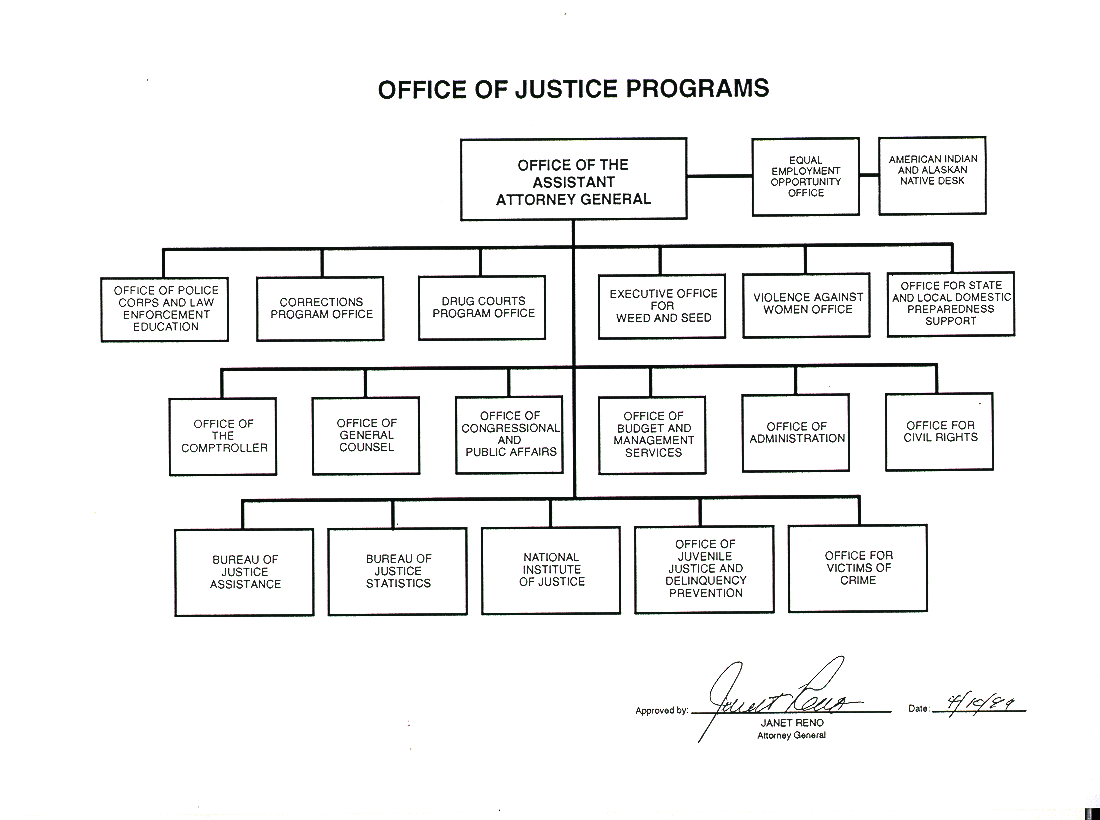
Office of Justice Programs(OJP)
Office of Community Oriented Policing Services(COPS)
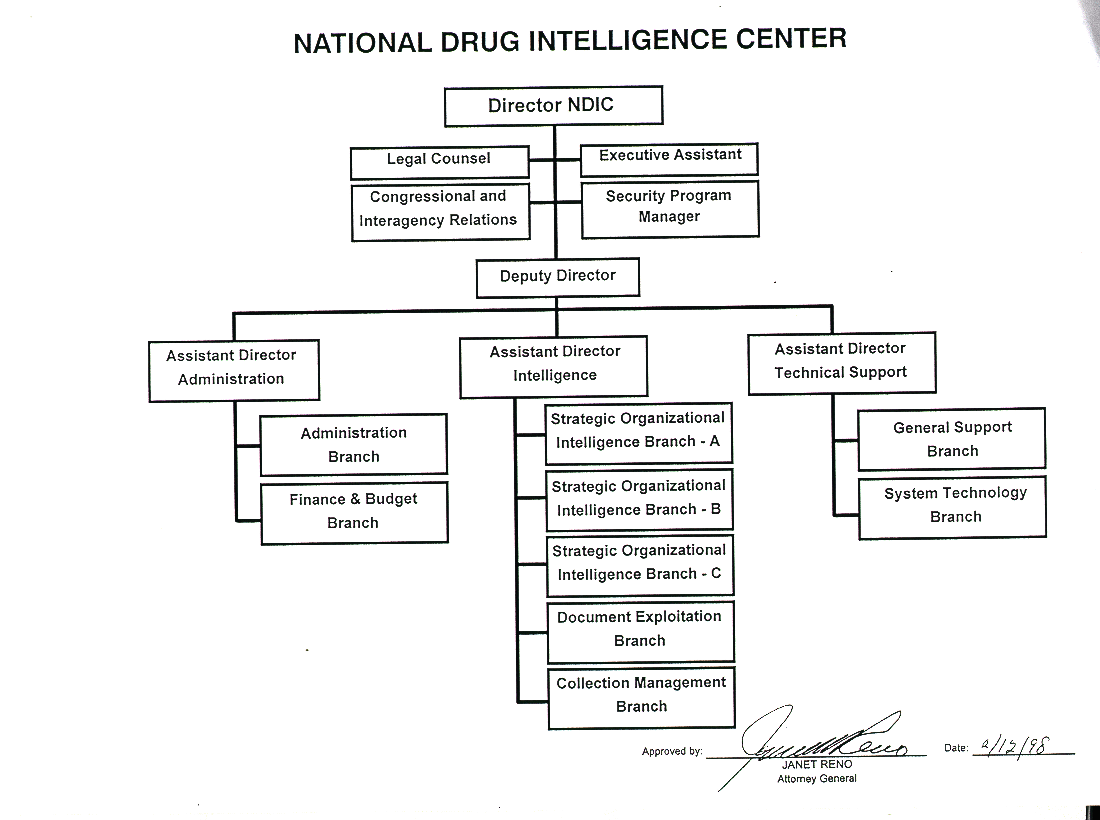
National Drug Intelligence Center(NDIC)
Professional Responsibility Advisory Office(PRAO)
The Department of Justice was established in June 1870 (28 U.S.C. 501, 503), with the Attorney General as its head. Prior to 1870 the Attorney General was a member of the President's Cabinet, but not head of a department, the office having been created in September 1789.
The Department represents the citizens of the United States in enforcing the law in the public interest and plays a key role in protection against criminals; ensuring healthy competition of business; safeguarding the consumer; enforcing drug, immigration, and naturalization laws; and protecting citizens through effective law enforcement. The Department conducts all suits in the Supreme Court in which the United States is concerned. It represents the Government in legal matters rendering legal advice and opinions, upon request, to the President and to the heads of the executive departments. The affairs and activities of the Department are generally supervised and directed by the Attorney General.
This manual contains the official organization charts and mission and function statements of the 38 components of the Department of Justice. The official organization chart of a component is that chart which has been signed by the Attorney General, or his/her predecessors if there have been no changes made since January 2000. The heads of a few organizations may sign their own organization charts but nevertheless must process their reorganization proposals through Department channels.
Under the direction of the Assistant Attorney General for Administration (AAG/A), the Justice Management Division, Management and Planning Staff (JMD/MPS) is responsible for coordinating the review and analysis of all reorganization proposals in accordance with Department of Justice Order 1000.2A. This includes notifying the Office of Management and Budget and the appropriate committees of the Congress, if necessary. All proposed reorganizations and/or changes to mission and function statements should be submitted to the AAG/A, JMD. Components are encouraged to reproduce and distribute this manual within their organizations, as required.
In an effort to be responsive to Department managers' needs, this manual will be updated and published on a semiannual basis: in January and July of each year. The current distribution list for this manual is included in Appendix A. If you are not currently included on the distribution list and would like to be, please fill out the distribution request form that is included in Appendix B and return it to the Management and Planning Staff (MPS) for appropriate action.
(AG)The position of Attorney General was created by the Judiciary Act of 1789. In June 1870, Congress enacted a law entitled "An Act to Establish the Department of Justice." This Act established the Attorney General as head of the Department of Justice and gave the Attorney General direction and control of U.S. Attorneys and all other counsel employed on behalf of the United States. The Act also vested in the Attorney General supervisory power over the accounts of U.S. Attorneys, U.S. Marshals, clerks, and other officers of the federal courts.
The mission of the Office of the Attorney General is to supervise and direct the administration and operation of the Department of Justice, including the Federal Bureau of Investigation, Drug Enforcement Administration, Immigration and Naturalization Service, Bureau of Prisons, Office of Justice Programs, and the Offices of U.S. Attorneys and U.S. Marshals, which are all within the Department of Justice.
The major functions of the Office of the Attorney General are to:
- Represent the United States in legal matters.
- Supervise and direct the administration and operation of the offices, boards,
divisions, and bureaus which comprise the Department.
- Furnish advice and opinions, formal and informal, on legal matters to the
President and the Cabinet and to the heads of the executive departments and
agencies of the Government, as provided by law.
- Make recommendations to the President concerning appointments to federal
judicial positions and to positions within the Department, including U.S.
Attorneys and U.S. Marshals.
- Represent or supervise the representation of the United States Government in the
Supreme Court of the United States and all other courts, foreign and domestic, in
which the United States is a party or has an interest as may be deemed
appropriate.
- Perform or supervise the performance of other duties required by statute or
Executive Order.
(DAG)On May 24, 1950, Attorney General J. Howard McGrath created the Office of the Deputy Attorney General.
The mission of the Office of the Deputy Attorney General is to advise and assist the Attorney General in formulating and implementing Department policies and programs and in providing overall supervision and direction to all organizational units of the Department.
The major functions of the Deputy Attorney General are to:
- Exercise all the power and authority of the Attorney General unless any such
power or authority is required by law to be exercised by the Attorney General
personally or has been specifically delegated exclusively to another Department
official.
- Except as assigned to the Associate Attorney General by 28 CFR § 0.19(a)(1),
exercise the power and authority vested in the Attorney General to take final
action in matters pertaining to:
1. The employment, separation, and general administration of personnel in the Senior
Executive Service and of attorneys and law students regardless of grade or pay in the
Department;
2. The appointment of special attorneys and special assistants to the Attorney General (28
U.S.C. 515(b));
3. The appointment of Assistant United States Trustees and fixing of their compensation;
and
4. The approval of the appointment by United States Trustees of standing trustees and the
fixing of their maximum annual compensation and percentage fees as provided in 28
U.S.C. 586(e).
(AAG)The Office of the Associate Attorney General (ASG) was created by Attorney General Order No. 699-77 on March 10, 1977.
As the third-ranking official at the Department of Justice, the Associate Attorney General is a principal member of the Attorney General's senior management team, and advises and assists the Attorney General and Deputy Attorney General on the formulation and implementation of Department of Justice policies and programs.
In addition to these duties, the ASG oversees the work of the Civil, Civil Rights, Antitrust, Tax, and Environment and Natural Resources Division. He also has oversight responsibility for the Office of Justice Programs, the Office of Tribal Justice, the Office of Dispute Resolution, the Office of Information and Privacy, the Community Relations Service, the Executive Office for United States Trustees, and the Foreign Claims Settlement Commission and for the implementation of the Violent Crime Control and Enforcement Act of 1994, including the Community Oriented Policing Services Program and the Violence Against Women Office.
(OSG)The Office of the Solicitor General was created by the Statutory Authorization Act of June 22, 1870. The Act states that there shall be an officer learned in the law, to be called the Solicitor General, to assist the Attorney General in the performance of his/her duties.
The mission of the Office of the Solicitor General is to represent the interests of the United States before the Supreme Court and to oversee appellate and certain other litigation on behalf of the United States in the lower federal and state courts.
The major functions of the Office of the Solicitor General are to:
- Conduct, or assign and supervise all Supreme Court cases, including appeals,
petitions for and in opposition to certiorari, briefs and arguments.
- Determine whether, and to what extent, appeals will be taken by the government
or whether the government will intervene in any appellate court.
- Determine when and whether the United States should intervene in any court to
defend the constitutionality of an Act of Congress.
- Assist the Attorney General, the Deputy Attorney General, and the Associate
Attorney General, as requested, in the development of Department programs and
policy.
(OIG)On April 14, 1989, the Office of the Inspector General (OIG) was created pursuant to the terms of the Inspector General Act Amendments of 1988, as further implemented by directive of the Attorney General. The OIG is structured into four operational components: the Audit Division; the Investigations Division; the Inspections Division; and the Management and Planning Division.
The mission of the Office of the Inspector General is to promote efficient and effective management within the Department of Justice and detect and deter wrongdoing in its programs and operations by the use and coordination of investigative, inspection, and audit resources.
The major functions of the OIG are to:
- Investigate violations of law and Department regulations for appropriate criminal
prosecution, civil litigation, and administrative action.
- Conduct, report, and follow up on financial audits of Departmental organizations,
programs, contracts, grants, and other agreements.
- Conduct, report, and follow up on performance audits and inspections of
programs and operations within or financed by the Department.
- Evaluate existing and proposed legislation and regulations affecting the
prevention and detection of fraud, waste, and abuse in Department programs and
operations.
- Report to the Attorney General and the Congress on problems and deficiencies in
the administration of Department and Department-financed programs and
operations; and progress made in implementing recommended corrective actions.
- Coordinate and cooperate with Federal, State, and local government agencies and
non-government entities to promote efficiency and effectiveness, and prevent and
detect fraud, waste, and abuse in programs and operations within or financed by
the Department.
(OLC)The Office of Legal Counsel (OLC) was created under 28 U.S. C. 511-513, which in part provides that the Attorney General shall give his/her advice and opinion on questions of law when required by the President or by heads of executive or military departments.
The mission of the Office of Legal Counsel is to assist the Attorney General in carrying out his/her statutory responsibility of furnishing legal advice to the President and the heads of the executive and military departments, and to provide legal advice and assistance to other components of the Department of Justice upon request.
The major functions of OLC are to:
- Draft the Attorney General's formal opinions and render its own opinions on a
variety of legal questions involving the operations of the Executive Branch.
- Review all proposed Executive Orders, certain Presidential proclamations, and
regulations requiring approval by the President or the Attorney General as to form
and legality.
- Render opinions to the Attorney General and to the heads of the various
organizational units of the Department on questions of law arising in the
administration of the Department.
- Render opinions to the White House and to the heads of executive departments
and agencies on questions of law.
- Advise the Attorney General in connection with the review of the Board of
Immigration Appeals and other organizational units of the Department.
- Prepare reports on proposed legislation submitted to the Department for comment,
and reports to the Office of Management and Budget on enrolled bills.
(OPD)The Office of Policy Development (OPD) was originally established in 1989 to replace the Office of Legal Policy, a component that had been formed in 1981, by merging the Office for Improvements in the Administration of Justice, the Office of Information Law and Policy, and the Office of Privacy and Information Appeals. Attorney General William P. Barr on May 19, 1992 realigned OPD and make it a part of the Office of Policy and Communications, together with Office of Public Affairs and the Office of Liaison Services. Attorney General Janet Reno reestablished OPD as a separate office on May 14, 1993.
The mission of the Office of Policy Development is to plan, develop, and coordinate the implementation of major policy initiatives of high priority to the Department and to the Administration; and to represent the Department of Justice in the Administration's judicial selection process for Article III judges.
The major functions of OPD are to:
- Assist the President and the Attorney General in filling all Article III and certain
Article I judicial vacancies as may occur during the Administration.
- Assure policy consistency and coordination of Departmental initiatives, briefing
materials, and policy statements.
- Conduct policy reviews of legislation and other proposals and support and
coordinate Departmental efforts to advance the Administration's legislative and
policy agenda.
- Develop strategies and programs to implement legislative, programmatic, and
policy initiatives.
- Coordinate regulatory development and the review of all proposed and final rules
developed by all Department components.
- Serve as liaison to OMB and other agencies on regulatory matters.
- Provide support and policy expertise in conjunction with other components to
implement effectively a number of major ongoing Departmental and
Administration initiatives in the criminal and civil justice areas.
- Implement the Department's "Volunteer to End Tribal Youth Violence"
(VETYV) initiative to assist American Indian tribes in their efforts to reduce
youth and gang violence through increased volunteerism.
- Track and coordinate Department implementation of statutory responsibilities and
reporting requirements.
- Coordinate the implementation of the Department's Pro Bono program.
- Implement the battered alien provisions and Attorney General Order provisions of
the welfare reform and immigration reform legislation of 1996.
(OIPR)The Office of Intelligence Policy and Review (OIPR) was created by Attorney General Order No. 875-80, 28 C.F.R., Part O, Subpart F-1, which was approved by Attorney General Civiletti in 1980.
The mission of the Office of Intelligence Policy and Review is to assist the Attorney General and other senior Justice Department officials in fulfilling national security-related responsibilities; to provide legal advice and guidance to various elements of the United States Government that are engaged in national security-related activities; and to oversee the implementation of the Foreign Intelligence Surveillance Act and other statutory, Executive Order, or Attorney General-based operational authorities for national security-related activities.
The major functions of OIPR are to:
- Advise and assist the Attorney General in carrying out his/her responsibilities
under Executive Order No. 12333, "United States Intelligence Activities."
- Serve as the Department representative on interdepartmental boards, committees
and other groups dealing with national security-related matters.
- Serve as the general point of contact between the Department and the National
Security Council.
- Participate in the development, implementation and review of United States
intelligence policies, including procedures for the conduct of intelligence and
counterintelligence activities.
- Evaluate existing and proposed national security-related activities to determine
their consistency with relevant policies and law.
- Formulate policy alternatives and recommend action by the Department and other
executive agencies in achieving lawful United States intelligence and
counterintelligence objectives.
- Draft, analyze and interpret current statutes, Executive Orders, guidelines, and
other directives pertaining to national security-related activities.
- Review and comment upon proposed statutes, guidelines, and other directives
with regard to intelligence activities; and, in conjunction with the Office of Legal
Counsel, review and comment upon the form and legality of proposed Executive
Orders that relate to the functions of this Office.
- Supervise the preparation of certifications and applications for orders under the
Foreign Intelligence Surveillance Act and represent the United States before the
United States Foreign Intelligence Surveillance Court.
- Recommend action by the Department of Justice with regard to applications for
foreign intelligence and counterintelligence electronic surveillance, as well as for
other investigative activities by Executive Branch agencies.
- Monitor intelligence and counterintelligence activities of other agencies to ensure
conformity with Department objectives.
- Prepare reports evaluating domestic and foreign intelligence and
counterintelligence activities and assessing trends or changes in these activities.
- Provide legal and policy advice regarding classification of national security
information and perform pre-publication review of materials proposed to be
published by present and former employees of the Department.
- Maintain and supervise the Intelligence Analysis Unit (IAU), which provides
liaison with the intelligence community and timely intelligence product to the
Attorney General and Deputy Attorney General, supporting their national security
responsibilities.
- Provide legal and policy advice regarding access to classified information,
including the granting and denial of security clearances.
(OPR)The Office of Professional Responsibility (OPR) was established by Attorney General Edward H. Levi under Attorney General Order No. 635-74, dated December 8, 1975 to investigate allegations of misconduct of Department of Justice employees.
Under Attorney General Order No. 1931-94, OPR has jurisdiction to investigate allegations of misconduct by Department of Justice attorneys that relate to the exercise of their authority to investigate, litigate or provide legal advice; and to investigate allegations of misconduct by law enforcement personnel when they are related to allegations of misconduct by attorneys within the jurisdiction of OPR.
The major functions of OPR are to:
- Receive and review allegations of misconduct by a Department attorney, criminal
investigator or other law enforcement personnel.
- Make such preliminary inquiry as may be necessary to determine whether the
matter should be referred to another component within the Department.
- Review instances of judicial findings of misconduct or judicial criticism of
Department attorneys to determine whether an investigation is warranted.
- Conduct full investigations of allegations of misconduct where warranted.
- Report its findings and conclusions regarding alleged misconduct to the
appropriate supervisory official.
- Make recommendations to the Attorney General and Deputy Attorney General on
what further specific action should be undertaken with regard to any matter
involving a violation of law, regulation, order or standard.
- Report significant violations of policies or procedures of the Department that
become evident in the course of an inquiry and submit recommendations which
may have significant impact on organizational or personnel realignments to the
Attorney General.
- Report findings of intentional, professional misconduct by Department attorneys
to the appropriate state attorney disciplinary authority.
- Serve as the Department's liaison to the National Organization of Bar Counsel.
- Prepare summaries of OPR investigations, findings and conclusions.
- Receive and review any allegations of reprisal against an employee or applicant
who discloses information concerning misconduct by a Department attorney,
criminal investigator or other law enforcement personnel.
- Recommend improvements in the present Department-wide reporting system in
which misconduct and criminal allegations against Department attorneys are
brought to the attention of this office and the Attorney General.
- Periodically report to the Attorney General significant trends in attorney
misconduct issues in the Department and recommend corrective action where
available.
- Support the Department's efforts to ensure that Department attorneys maintain the
highest ethical standards by participating in training seminars, conferences, and
policy development initiatives as appropriate.
(OLA)The Office of Legislative Affairs (OLA) was established in the Department of Justice on February 2, 1973, by Attorney General Order 504-73 to be the coordinating center for all Department of Justice activities relating to legislation and the Congress. The Office was subsequently reorganized into the Office of Legislative and Intergovernmental Affairs on January 24, 1984, by Attorney General Order No. 1054-84. Attorney General Order 1097-85 reestablished the Office of Legislative Affairs as an independent office on February 4, 1986.
The mission of the Office of Legislative Affairs is to advise appropriate components of the Department on the Congressional positions and preferences in the development of the Department's official policies with respect to legislation initiated inside the Department, by other parts of the executive Branch, or by Members of Congress and to explain and advocate those policies with maximum effectiveness with the Congress. The Office also serves as the Attorney General's focal point for dealing with Department nominees, Congressional oversight, Congressional correspondence and Congressional requests for documents and access to Department employees.
The major functions of OLA are to:
- Maintain liaison between the Department and the Congress.
- Manage and direct all legislative functions between Congress and the Department.
- Consult with and advise the Attorney General, the Deputy Attorney General and
the Associate Attorney General on controversial matters and policy
considerations, important policy decisions, new legislative initiatives, and priority
decisions.
- Serve as the Department's spokesperson with the Congress.
- Issue guidelines or instructions in order to assure a coordinated approach is being
taken on legislative actions.
- Participate in the coordination of the Department's position on all proposed
legislation.
(OIA)The Office of Intergovernmental Affairs (OIA) was established in the Department of Justice by Attorney General Janet Reno on June 23, 1996, to be the coordinating center all Department of Justice activities relating to intergovernmental affairs and relations with or information dissemination to most interest groups.
The mission of the Office of Intergovernmental Affairs is to coordinate the Attorney General's and other leadership officials' relationships with state and local government and the interest groups which represent them; to provide advice on strategic planning of the Attorney General's public appearances; to perform speech writing duties for the Attorney General and the Deputy Attorney General as needed; to provide event-planning and consulting services to the Attorney General and the Deputy Attorney General; and to advise and assist, as required, the White House on these same issues.
The major functions of OIA are to:
- Identify, recommend, and facilitate the solution of emerging intergovernmental
issues and recommend and coordinate personal involvement by the Attorney
General and other leadership officials, as well as White House officials, including
the President and Vice President.
- Maintain liaison between the Department and various divisions and bureaus of the
Department and the state, county and local governments, leaders of organizations
that represent state and local governments, some professional organizations, and
some special interest groups.
- Represent the Attorney General and the Department in frequent contacts with
officials of these groups.
- Coordinate Department policies and priorities related to these groups.
- Ensure that the Department's policies and positions on a variety of complicated
matters are clearly communicated to these groups.
(OIP)The Office of Information and Privacy (OIP) was established as an independent office by Attorney General Janet Reno on May 14, 1993.
The mission of the Office of Information and Privacy is to manage and coordinate the discharge of the Department of Justice's responsibilities under the Freedom of Information Act (FOIA) and the Privacy Act of 1974, through the coordination of compliance with the FOIA within all Federal agencies and compliance with the Privacy Act within the Department of Justice.
The major functions of OIP are to:
- Act on behalf of the Attorney General on administrative appeals under the FOIA
and the Privacy Act from denials by all components of the Department of Justice.
- Provide staff support to the Department Review Committee, which acts on the
Attorney General's behalf in making the Department's final national security
classifications decisions under Executive Order 12958.
- Act on all initial FOIA and Privacy Act requests for records of the Offices of the
Attorney General, Deputy Attorney General, Associate Attorney General, and
other senior leadership offices of the Department.
- Promote agency compliance with the FOIA through government-wide policy
development and dissemination activities, which include:
1. Publishing FOIA Update; the Freedom of Information Act Guide & Privacy Act
Overview; and the Freedom of Information Case List.
2. Providing both agency-specific and government-wide training to Federal agency
employees at basic, intermediate, and advanced levels.
3. Responding to requests from Federal agency personnel who seek information, advice,
and policy guidance on FOIA related matters, through its FOIA Counselor service.
(OPA)The Office of Public Affairs (OPA) is responsible for performing those duties described in 28 Code of Federal Regulations, Subpart E-3 § 0.28.
The mission of the Office of Public Affairs is to coordinate the relations of the Department of Justice with the news media and serve as the center for information about all organizational units of the Department.
The major functions of OPA are to:
- Ensure that the public is informed about the Department's activities and about the
priorities and policies of the Attorney General and the President in the fields of
law enforcement and legal affairs.
- Advise the Attorney General and other Department officials on all aspects of
media relations and communications issues.
- Coordinate the public affairs units of all Department component organizations.
- Prepare and issue all news releases for headquarters, and edit and approve some of
those issued by component agencies.
- Serve reporters assigned to the Department by responding to queries, issuing new
releases and statements, arranging interviews and conducting news conferences.
- Ensure that information provided to the news media by the Department is current,
complete and accurate.
- Ensure that all applicable laws, regulations and policies involving the release of
information to the public are followed so that material is not made public that
might jeopardize investigations and prosecutions, violate rights of defendants or
potential defendants or compromise national security interests.
(ODR)The Office of Dispute Resolution (ODR) was originally established in the Department of Justice within the Office of the Associate Attorney General. On January 26, 1998, ODR was established as an independent component by Attorney General (AG) Janet Reno pursuant to AG Order No. 1160.1 which directed that there shall be created within the Department the position of Senior Counsel for Alternative Dispute Resolution.
The mission of the Office of Dispute Resolution is to promote the broader use of alternative dispute resolution (ADR) in appropriate cases to improve access to justice for all citizens and to lead to more effective resolution of disputes involving the government.
The major functions of ODR are to:
- Assist senior management in developing policies for the use of ADR, including
revising the Department guidance on the use of ADR for litigation in the Federal
courts.
- Assist with the design and execution of ADR related training, record keeping,
program evaluation and reporting functions.
- Provide advice and assistance to Department supervisors and employees on
selecting appropriate cases for using ADR and on the application of particular
ADR techniques.
- Report regularly to the Attorney General, through the Associate Attorney General,
on the status of the Department's ADR activities.
- Represent the Department in government-wide ADR activities, including
programs and projects with the Administrative Conference of the United States,
the Office of Management and Budget, the National Performance Review, and the
Federal courts.
- Advise senior management on legislation, rule making, and other policy matters
relating to ADR.
- Serve as the Dispute Resolution Specialist for the Department as defined in
Section 3(b) of the Administrative Dispute Resolution Act, 104 Stat. at 2737.
- Perform such other duties and functions related to the promotion of ADR as may
be assigned by the AG, the Deputy Attorney General and the Associate Attorney
General.
- Serve as the AG designee to monitor and supervise the day-to-day activities of the
Alternative Dispute Resolution Coordinating Committee and its working groups.
(JMD)In 1973, under Attorney General Elliot Richardson, it was proposed to strengthen the Department-wide staff capability in the areas of management and finance by establishing the Office of Management and Finance. In 1979 a reorganization under Attorney General Benjamin Civiletti eliminated the Office of Management and Finance and created the Justice Management Division (JMD).
The mission of the Justice Management Division is to provide advice to senior management officials relating to basic Department policy for budget and financial management, personnel management and training, procurement, equal employment opportunity, information processing, telecommunications, security, and all matters pertaining to organization, management, and administration.
The major functions of JMD are to:
- Conduct, direct, review, and evaluate management studies and surveys of the
Department's organizational structure, functions and programs, operating
procedures and supporting systems, and management practices throughout the
Department.
- Supervise, direct, and review the preparation, justification and execution of the
Department budget, including the coordination and control of the programming
and reprogramming of funds.
- Review, analyze, and coordinate the Department's programs and activities to
ensure that the Department's use of resources and estimates of future requirements
are consistent with the policies, plans, and mission priorities of the Attorney
General.
- Plan, direct, and coordinate Department-wide personnel management programs,
and develop and issue Department-wide policy in all personnel program areas.
- Develop and direct Department-wide financial management policies, programs,
procedures, and systems including financial accounting, planning, analysis, and
reporting.
- Supervise and direct the operations of the Department's automated information
services, publication services, library services and any other Department-wide
central services which are established by or assigned to the JMD.
- Formulate and administer the General Administration Appropriation of the
Department's budget.
- Develop and direct a Department-wide directives management program and
administer the directives management system.
- Plan, direct, administer and monitor compliance with Department-wide policies,
procedures, and regulations concerning records, reports, procurement, printing,
graphics, audiovisual activities (including the approval or disapproval of
production and equipment requests), forms management, supply management,
motor vehicles, real and personal property, space assignment and utilization, and
all other administrative services functions.
- Formulate Department policies, standards, and procedures for information
systems and the management and use of automatic data processing equipment.
- Formulate policies, standards, and procedures for Department telecommunications
systems and equipment and review their implementation.
- Provide computer and digital telecommunications services on an equitable
resource-sharing basis to all organizational units within the Department.
- Direct all Department security programs including personnel, physical, document,
information processing and telecommunications, special intelligence, and
employee health and safety programs and formulate and implement Department
defense mobilization and contingency planning.
- Review legislation for potential impact on the Department's resources.
- Establish policy and procedures related to debt collection.
- Develop, direct, coordinate and monitor compliance with Department-wide
policies and programs for implementing an effective and viable equal employment
opportunity program which includes affirmative employment initiatives and
procedures for the timely and equitable processing of discrimination complaints.
(EOUSA)The Executive Office for United States Attorneys (EOUSA) was created on April 6, 1953, by Attorney General Order No. 8-53, to meet a need for closer liaison between the Department of Justice in Washington, D.C. and the United States Attorneys. The Executive Office is under the supervision of the Deputy Attorney General.
The mission of the EOUSA is to provide general executive assistance to the 94 Offices of the United States Attorney; and to coordinate the relationship between the United States Attorneys and the organizational components of the Department of Justice and other federal agencies.
The major functions of the EOUSA are to:
- Facilitate coordination between the Offices of the United States Attorney and
other organizational units of the Department of Justice.
- Evaluate the performance of the Offices of the United States Attorney, making
appropriate reports and inspections and taking corrective action where indicated.
- Publish and maintain a United States Attorneys' Manual and a United States
Attorneys' Bulletin for the internal guidance of the United States Attorneys'
offices and those other organizational units of the Department concerned with
litigation.
- Supervise the operation of the Office of Legal Education, (the Attorney General's
Advocacy Institute, and the Legal Education Institute), which develops, conducts
and assists in the training of all Department of Justice legal personnel and other
federal legal personnel.
- Provide the Attorney General's Advisory Committee of United States Attorneys
and all of its subcommittees, with such staff assistance and funds as are
reasonably necessary to carry out the Committee's responsibilities.
- Provide support to the Deputy Attorney General regarding United States Attorney
appointments.
- Plan and execute United States Attorneys' conferences and other conferences in
the direct support of the United States Attorney; management of their offices.
- Provide general direction and supervision of the management and policy activities
of the United States Attorneys' legal programs, including debt collection, health
care fraud, affirmative civil enforcement, asset forfeiture, bank fraud and
bankruptcy litigation.
- Provide litigating and technical support, training, coordination, and
implementation of legislative initiatives in legal program areas. This includes the
tracking and analysis of areas designated by the Attorney General as national
priorities.
- Establish, coordinate, and interpret policy, guidelines, and procedures on criminal
fine collection issues.
- Provide general legal interpretations, opinions, and advice to United States
Attorneys in areas of refusals, cross-designations, outside activities,
representation, allegations of misconduct, adverse actions, grievances, labor
relations, and ethical and conflict of interest questions.
- Provide general support to the United States Attorneys in matters involving
Assistant United States Attorneys and Special Assistant United States Attorney
appointments.
- Promote, facilitate, and monitor programs with the Offices of the United States
Attorney designated by the Attorney General as priorities of the Department.
- Provide overall administrative management oversight, technical and direct support
to the United States Attorneys in the program areas of facilities management (to
include acquisition of real property/space, construction, renovation, repair and
relocation); and support service programs (to include personal property
management, simplified acquisition, motor vehicle support, records disposition,
forms management, audio visual, graphics, printing, metered mailing, and
telephone systems).
- Provide management oversight, technical and direct support to the United States
Attorneys in the planning, development, implementation, and administration of
comprehensive security programs encompassing all aspects of physical,
communication, information, personnel and computer security.
- Analyze, design, and provide automated services and systems in support of the
litigation mission and of selected administrative functions of the United States
Attorneys' offices including development, implementation, and monitoring of
policies and programs for office automation, systems development activities and
data base maintenance.
- Arrange for the acquisition and installation of integrated office automation
systems in the Offices of the United States Attorney.
- Provide technical support to users of automated systems in the Offices of the
United States Attorney to manage and support the acquisition and maintenance of
office automation equipment.
- Design, program, and support the operations and software for caseload and
collections systems and administrative/litigative applications in the districts and
the central systems, provide technical assistance, produce the annual Statistical
Report, and monitor the quality of the data of the Office of the United States
Attorney.
- Formulate, implement and administer bureau-level human resource management
policies and programs for the 94 United States Attorneys' offices (USAOs)
located nationwide. Programs affect Assistant United States Attorneys appointed
under Title 28 and compensated under a separate pay system; as well as support
staff appointed under Title 5, USC. Provide technical oversight of USAOs
delegated personnel authorities, and provide operating personnel and
pre-employment security services to the other USAOs.
- Support the Offices of the United States Attorneys in the conduct of their Law
Enforcement Coordination Programs as directed by the Attorney General--provide
training and guidance; assistance in providing speakers, materials, and any other
technical assistance for LECC-related functions; acting as liaison with the LEC-VW
Subcommittee of the Attorney General's Advisory Committee; and the
promotion of the LECC Program throughout the federal and local government.
- Serve as liaison on Victim-Witness assistance activities within the Offices of the
United States Attorney, supporting the United States Attorneys in their efforts to
ensure compliance with the Attorney General's Guidelines in relation to victim
and witness assistance.
- Manage the United States Attorneys' appropriation including direct and indirect
budget authority and personnel resources. Provide budget and fiscal assistance
and guidance to the 94 Offices of the United States Attorney.
- Track, provide, and analyze data related to the work of the United States
Attorneys' offices in the development of budget and litigative priorities.
- Respond to requests under the Freedom of Information Act and Privacy Act on
behalf of the Offices of the United States Attorney, coordinate and respond to
litigation arising from these matters and provide advice and training to the United
States Attorneys' staffs relating to FOIA/PA.
- Provide centralized leadership, coordination and evaluation of all equal
employment efforts throughout the Offices of the United States
Attorney-administering both the Affirmative Action and Complaints Processing
Programs.
- Respond to inquiries from members of Congress and private citizens and review
and comment on legislative and regulatory proposals relating to the activities of
the Offices of the United States Attorney.
- Provide technical, administrative, design, and maintenance support in the area of
video telecommunications to enhance cooperative efforts among the Offices of
United States Attorney and the Litigating Divisions of the Department.
- Provide information and guidance to United States Attorneys' offices on pending
legislation pertinent to the work of the United States Attorneys' offices; prepare
testimony and background for Congressional oversight and appropriations
hearings.
(ATR)The Division's organizational roots can be traced to the creation of an Assistant to the Attorney General in March 1903, to take charge of all suits under the antitrust and interstate commerce laws, and to assist the Attorney General and the Solicitor General in the conduct of the general executive work of the Department. The post was created under President Theodore Roosevelt and Attorney General Philander Knox. With the growth of the economy and of corporate enterprise, it became evident that the Department of Justice must have its own corps of specialists in antitrust law to cope with an increasingly complex enforcement situation. Consequently, in 1933, under the administration of President Franklin D. Roosevelt and Attorney General Homer S. Cummings, the Antitrust Division was established.
The mission of the Antitrust Division is to promote and maintain competition in the United States economy.
The major functions of the Division are to:
- Seek to prevent or terminate private anti-competitive conduct which is subject to
criminal and civil action under the Sherman and Clayton Acts and related statutes
that prohibit conspiracies in restraint of trade, monopolization and anti-competitive mergers.
- Through participation in the Executive Branch, regulatory and legislative
processes, seek to ensure that government action is pro-competitive or not
unnecessarily anti-competitive.
- Assemble information and prepare reports required or requested by the Congress
or the Attorney General as to the effect upon the maintenance and preservation of
competition under the free enterprise system of various federal laws or programs.
- Review proposed mergers and acquisitions to assess their competitive effect and
challenge those that threaten to harm competition.
- Develop and present legislative proposals of the Department relating to the
antitrust laws and competition generally and respond to requests for advice and
comments on such matters from Congress and from other agencies.
- Advise the President and the departments and agencies of the Executive Branch
on the competitive implications of governmental action.
- Investigate possible violations of the federal antitrust laws, conduct grand jury
proceedings, issue and enforce civil investigative demands, and handle all
litigation that arises out of these criminal and civil investigations.
- Investigate and prosecute violations of criminal law that affect the integrity of the
investigatory process, and enforce various criminal statutes related to Sherman
Act violations.
(CIV)In 1868 Congress gave the Attorney General the responsibility of representing the United States in all cases brought before the Court of Claims for any contract, agreement, or transaction with the executive departments, bureaus, or offices of executive departments. After the creation of the Department of Justice in 1870, a unit evolved within it that became known as the Division for the defense of claims against the United States or the Courts of Claims Division. The Attorney General created a new Claims Division in 1933 that consolidated responsibility for most of the litigating areas that comprise the present day Civil Division. Finally, in 1953, Attorney General Herbert Brownell, Jr., changed the name of the Claims Division to the Civil Division and broadened its responsibilities to include the litigation of the disbanded Customs Division. The Civil Division received additional responsibility for immigration and consumer protection litigation in 1983.
The mission of the Civil Division is to represent the interests of the United States fairly, successfully, and consistently in civil litigation and selected criminal cases.
The major functions of the Division are to:
- Defend or assert the programs and initiatives of the Federal Government,
including the President's domestic and foreign policy initiatives and the statutory
and regulatory integrity of many other federal programs.
- Bring suit to collect money owed the United States by delinquent debtors and
recover sums lost to the government through waste, fraud, and corruption.
- Defend the government and its officers and employees in lawsuits seeking
damages from the United States Treasury or from its employees personally.
- Enforce federal consumer protection laws, the nation's immigration laws and
policies, and other program initiatives.
(CRT)The Civil Rights Division was established in the Department of Justice by the passage of the Civil Rights Act of 1957. Prior to the creation of the Division, the Department's civil rights enforcement efforts were conducted by a section of the Department's Criminal Division.
The mission of the Civil Rights Division is to enforce the Civil Rights Act of 1957, 1960, 1964 and 1968, as amended; the Voting Rights Act of 1965, as amended; the Equal Credit Opportunity Act, as amended; the Fair Housing Act of 1968 and the Fair Housing Amendments Act of 1988; Executive Order 12250 (inter alia, Title VI, Title IX and Section 504 of the Rehabilitation Act of 1973, as amended); and the Civil Rights of Institutionalized Persons Act.
The Division also enforces the Freedom of Access to Clinic Entrances Act; the Police Misconduct Provision of the Violent Crime Control and Law Enforcement Act of 1994; and Section 102 of the Immigration Reform and Control Act of 1986 (IRCA), as amended, which prohibits discrimination on the basis of national origin and citizenship status as well as document abuse and retaliation. In addition, the Division is charged with all Departmental responsibilities under the Americans with Disabilities Act of 1990 (ADA); the ADA assures equal opportunity for individuals with disabilities in employment, public accommodations and services, transportation, and telecommunications.
The major functions of the Division are to:
- Investigate and, when warranted by the findings, initiate legal proceedings
seeking injunctive and other relief in cases involving discrimination in areas of
education, credit, employment, housing, public accommodations and facilities,
federally funded programs, voting, and the rights of prisoners, mentally and
physically disabled persons and senior citizens.
- Prosecute violations of criminal statutes which prohibit specified acts of
interference with federally protection rights and activities, such as conspiracies to
interfere with or deny a certain individual or group of individuals the exercise of
these rights.
- Rule on voting changes and recommend observer and examiner activities covered
under the special provisions of the Voting Rights Act of 1965, as amended.
- Implement Executive Order 12250 by studying, reviewing and approving
regulatory changes proposed by all Federal Executive Branch agencies as they
pertain to civil rights, including Titles VI and IX and Section 5 of the
Rehabilitation Act of 1973, as amended.
- Under the ADA, coordinate the technical assistance activities of other federal
agencies and provide technical assistance to places of public accommodation and
state and local governments.
- Serves as the principal advisor to the Attorney General on all matters pertaining to
civil rights.
- Provide Department representation to an maintain close liaison and cooperation
with principal officials and representatives of other divisions, federal agencies,
state and municipal governments and private organizations on subjects relating to
civil rights issues.
(CRM)The Criminal Division was created by Attorney General Palmer in his reorganization of the Department of Justice in 1919.
The mission of the Criminal Division is to serve the public interest through the development and enforcement of criminal statutes in a vigorous, fair and effective manner; and to exercise general supervision over the enforcement of all federal criminal laws, with the exception of those statutes specifically assigned to the Antitrust, Civil Rights, Environment and Natural Resources, or Tax Divisions.
The major functions of the Division are to:
- Formulate criminal law enforcement policies and guide their implementation
throughout the federal justice system.
- Conduct criminal investigations, including grand jury proceedings, and litigation
in major cases arising from offenses against the statutes supervised by the
Division.
- Mediate the interactions of the various Executive Branch agencies responsible for
the enforcement of Federal criminal laws, especially the U.S. Attorneys and the
federal investigative agencies, in areas where their responsibilities intersect.
- Supervise the application of sensitive law enforcement techniques such as the use
of electronic surveillance, the authorization of immunity from federal prosecution,
and the provision of witness protection measures.
- Negotiate with foreign governments for assistance in criminal law enforcement
matters, coordinate the acquisition of such assistance in specific instances, and
arrange for reciprocal assistance from the United States as appropriate.
- Decide petitions from remission or mitigation of judicial forfeitures, authorize the
transfer of forfeited property to state and local law enforcement as provided under
the equitable sharing program, and assist federal prosecutors with civil and
criminal forfeiture litigation.
- Investigate possible instances of wrongful entry into the United States and
conduct civil law enforcement proceedings relative to the denaturalization and
deportation of alleged Nazi war criminals residing in the United States.
- Supervise other civil litigation pertaining to law enforcement activities.
- Support U.S. policy by providing assistance to foreign criminal justice systems
based on internally recognized principles of humans rights and the rule of law.
(ENRD)The Public Lands Division of the Department of Justice was created on November 16, 1909, by Circular No. 114. It was given the name Lands Division on December 30, 1933 by Attorney General Order No. 2507, and was designated the Land and Natural Resources Division on October 18, 1965. In order to more accurately described the focus of the Division in its working title, the Division name was changed to the Environment and Natural Resources Division in April 1990.
The mission of the Environment and Natural Resources Division is, through litigation in the federal and state courts, to safeguard and enhance the American environment; acquire and manage public lands and natural resources; and protect and manage Indian rights and property.
The major functions of the Division are to:
(TAX)On June 10, 1933, Executive Order No. 6166 was issued, which transferred to the Department of Justice "functions of prosecuting in the courts of the United States claims and demands by, and offenses against, the Government of the United States and of defending claims and demands against the Government exercised by an agency or officer." On January 1, 1934, the Tax Division was formally organized to supervise and conduct the Government's tax litigation.
The mission of the Tax Division is to represent the United States and its officers in civil and criminal litigation arising under the internal revenue laws, other than proceedings in the United States Tax Court.
The major functions of the Division are to:
- Prosecute and defend in all courts, other than the Tax Court, civil suits, and the
handling of other matters, arising under the internal revenue laws, and litigation
resulting from the taxing provisions of other Federal statues.(1) These matters
primarily include: defending the United States in tax refund suits, representing the
interests of the United States in bankruptcy cases involving federal tax claims,
enforcing administrative summonses, instituting collection actions, and defending
tort actions against Internal Revenue Service officials.
- Enforce the criminal tax laws by supervising or directly handling all criminal
proceedings arising under the internal revenue laws.(2) Criminal prosecutions
handled or supervised by the Division primarily include cases involving the
violation of criminal tax laws by taxpayers. The Division also handles tax
violations arising in cases involving financial institution fraud, health care fraud,
organized crime activities, and narcotic trafficking.- Enforce tax liens, mandamus, injunctions, and other special actions or general
matters arising in connection with internal revenue matters.
- Handle appellate proceedings in connection with civil and criminal cases.
- Serve as consultant and advisor on questions of major policy and matters
pertaining to the Division's handling of civil litigation in the trial courts; for
formulating policy, strategy, and tactics; and for coordinating civil trial activities
in order to focus attention and resources upon the most important cases and legal
issues.
- Serve as consultant and advisor on questions of major policy and matters
pertaining to the Division's defense and prosecution of both civil and criminal
appeals in the various appellate courts.
- Supervise active legislative proposals and special projects aimed at developing
legislative remedies for tax administration problems, as well as the assessment of
the litigative impact of already enacted legislation and the formulation of litigative
tax policies.
(BOP)The Federal Bureau of Prisons (BOP) was created by the Act of May 14, 1930 (ch.274,-46 Stat.325) and signed into law by President Herbert Hoover.
The mission of the Federal Bureau of Prisons is to maintain secure, safe, and humane correctional institutions for individuals placed in the custody of the U.S. Attorney General; to develop and operate correctional programs that seek a balanced application of the concepts of punishment, deterrence, incapacitation and rehabilitation; and provide, primarily through the National Institute of Corrections, assistance to state and local correctional agencies.
The major functions of the BOP are to:
Population Management
Human Resource Management
Security and Facility Management
Correctional Leadership and Effective Public Administration
Inmate Programs and Services
Building Partnership
FEDERAL PRISON INDUSTRIES
The Federal Prison Industries, Inc., (FPI) a wholly-owned government corporation, was created by statue (P.L. 73-461) on June 23, 1934 and implemented by Executive Order No. 6917 signed by President Roosevelt on December 11, 1934.
The mission of the Federal Prison Industries, Inc., is to provide training and employment of prisoners confined in Federal Correctional Institutions.
The major functions of the FPI are to:
- Exercise jurisdiction over industrial enterprises of all Federal Correctional
Institutions.
- Maintain a diversified program of industrial operations which ensure optimum
inmate employment.
- Provide a wide range of products and services to other Federal agencies at fair
market prices, structuring product lines to minimize competition with private
sector industry and labor in any one product or service area.
NATIONAL INSTITUTE OF CORRECTIONS
The National Institute of Corrections (NIC) is a national center of assistance to state and local correctional agencies, and works to advance the practice of corrections throughout the country. The NIC was created by statue (P.L. 93.415) on September 7, 1974.
The mission of the NIC is to improve the management and operation of correctional systems and encourage and assist in the development of more effective, humane, safe, just, and constitutional correctional programs.
The major functions of the NIC are to:
- Provide assistance to state and local correctional agencies, and work to advance
the practice of corrections throughout the country.
- Provide training, technical assistance, and clearinghouse services, and undertake
research, evaluation and policy formulation activities to advance correctional
practices in many different areas.
(DEA)In 1968, the Justice Department's Bureau of Narcotics and Dangerous Drugs was formed. The organization then was composed of personnel from the Federal Bureau of Narcotics (Treasury Department) and the Bureau of Drug Abuse Control (Food and Drug Administration) of the Department of Health, Education and Welfare. In 1973, the Drug Enforcement Administration (DEA) was created by merging the Bureau of Narcotics and Dangerous Drugs, the Office for Drug Abuse Law Enforcement, the Office of National Narcotics Intelligence, elements of the U.S. Customs Service that worked in drug trafficking intelligence and investigations, and the Narcotics Advance Research Management Team.
The mission of the DEA is to enforce the controlled substance laws and regulation of the United States and to bring to the criminal and civil justice system of the United States, or any other competent jurisdiction, those organizations, and principal members of organizations, involved in the growing, manufacture, or distribution of controlled substances appearing in or destined for illicit traffic in the United States; and to recommend and support non-enforcement programs aimed at reducing the availability of illicit controlled substances on the domestic and international markets.
In carrying out its mission as the agency responsible for enforcing the controlled substance laws and regulations of the United States, DEA's primary responsibilities include:
- Investigation and preparation for the prosecution of major violators of controlled
substances laws operating at interstate and international levels.
- Investigation and preparation for prosecution of criminals and drug gangs who
perpetrate violence in our communities and terrorize citizens through fear and
intimidation.
- Management of a national drug intelligence program in cooperation with federal,
state, local, and foreign officials to collect, analyze, and disseminate strategic and
operational intelligence information.
- Seizure and forfeiture of assets derived from, traceable to, or intended to be used
for illicit drug trafficking.
- Enforcement of the provisions of the Controlled Substances Act as they pertain to
the manufacture, distribution and dispensing of legally produced controlled
substances.
- Coordination and cooperation with federal, state and local law enforcement
officials on mutual drug enforcement efforts and enhancement of such efforts
through exploitation of potential interstate and international investigations beyond
local or limited federal jurisdictions and resources.
- Coordination and cooperation with other federal, state and local agencies, and
with foreign governments, in programs designed to reduce the availability of
illicit abuse-type drugs on the United States market through non-enforcement
methods such as crop eradication, crop substitution, and training of foreign
officials.
- Responsibility, under the policy guidance of the Secretary of State and U.S.
Ambassadors, for all programs associated with drug law enforcement counterparts
in foreign countries.
- Liaison with the United Nations, INTERPOL, and other organizations on matters
relating to international drug control programs.
(FBI)In 1908, Attorney General Charles Joseph Bonaparte issued an Order creating an investigative agency with the Department of Justice. The Order was confirmed in 1909 by Attorney General George W. Wickersham who ordered the establishment of the Bureau of Investigation. The present name, Federal Bureau of Investigation (FBI), was designated by Congress in 1935.
The mission of the FBI is to uphold the law through the investigation of violations of federal criminal law; to protect the United States from foreign intelligence and terrorist activities; to provide leadership and law enforcement assistance to federal, state, local and international agencies; and to perform these responsibilities in a manner that is responsive to the needs of the public and is faithful to the Constitution of the United States.
The major functions of the FBI are to:
- Investigate violations of the laws of the United States and collect evidence in
cases in which the United States is or may be a party in interest, except in cases in
which such responsibility is by statute or otherwise specifically assigned to
another investigative agency.
- Conduct professional investigations and authorized intelligence collection to
identify and counter the threat posed by domestic and international terrorists and
their supporters within the U.S. In furtherance of this function, the FBI designs,
develops and implements counter-terrorism initiatives which enhance the FBI's
ability to minimize the terrorist threat.
- Conduct counterintelligence activities and coordinate counterintelligence
activities of other agencies in the intelligence community within the United
States. (Executive Order 12333 includes international terrorist activities in its
definition of counterintelligence.)
- Locate and apprehend fugitives for violations of specified federal laws and, when
so requested, state and local fugitives pursuant to federal statutory authority as the
sole federal agency so mandated.
- Coordinate the efforts of U.S. Government agencies and departments in protecting
the nation's Critical Infrastructure by identifying and investigating criminal and
terrorist group intrusions through physical and cyber attacks.
- Address international criminal organizations and terrorist groups, which threaten
the American people and their property, through expanded international liaison
and through the conduct of extraterritorial investigations as mandated by laws and
Executive Order.
- Conduct personnel investigations requisite to the work of the Department of
Justice and whenever required by statute or otherwise.
- Establish and conduct law enforcement training programs and conduct research to
provide assistance to state and local law enforcement personnel. Participate in
interagency law enforcement initiatives which address crime problems common to
federal/state/local agencies.
- Develop new approaches, techniques, systems, equipment and devices to improve
and strengthen law enforcement and assist in conducting state, local and
international law enforcement training programs.
- Acquire, collect, exchange, classify and preserve arrest and identification records
from criminal justice and other governmental agencies, including fingerprint
cards/images voluntarily submitted by individuals for personal identification
purposes.
- Operate a central clearinghouse for police statistics under the Uniform Crime
Reporting Program, and a computerized nationwide index of law enforcement
information under the National Crime Information Center.
- Operate the Federal Bureau of Investigation Laboratory to serve not only the FBI,
but also to provide, without cost, technical and scientific assistance, including
expert testimony in federal or local courts, for all duly constituted law
enforcement agencies, other organizational units of the Department of Justice, and
other federal agencies; and to provide identification assistance in mass disasters
and for other humanitarian purposes.
- Review and assess operations and work performance to ensure compliance with
laws, rules and regulations and to ensure efficiency, effectiveness, and economy
of operations.
- Effectively and appropriately communicate information on FBI policy,
operations, accomplishments and on national crime statistics to Congress, the,
media, and the public.
(INS)A Bureau of Immigration was first established in the Treasury Department in 1891. In 1903, it was transferred to the Department of Commerce and Labor. Two years later, under the terms of the Act of June 29, 1906, providing for the Federal supervision of naturalization, the Bureau of Immigration became the Bureau of Immigration and Naturalization. Under Reorganization Plan No. V on June 14, 1940, the Immigration and Naturalization Service (INS) was transferred to the Department of Justice.
The mission of the INS is to facilitate entry of those legally admissible as visitors or immigrants and to grant them benefits to which they are entitled; prevent improper entry and the granting of benefits to those not legally entitled to them; apprehend and remove those aliens who enter illegally and/or whose stay is not in the public interest; and to enforce sanctions against those who act or conspire to subvert the requirements for selective and controlled entry, including sanctions against employers who knowingly hire aliens not authorized to work in the United States.
The major functions of the INS are to:
- Determine the admissibility of persons seeking entry into the country, ensure
appropriate documentation at entry, and control the status of aliens in the country
during their stay.
- Provide service to the public including adjudication of applications and petitions
submitted for benefits under the Immigration and Nationality Act and the
Immigration Reform and Control Act of 1986; process naturalization and
citizenship petitions and applications; and provide information and forms to
clients at INS office.
- Patrol the borders of the United States to prevent entry of aliens into the country
in violation of the law.
- Deter future illegal entry and stay, including enforcement of criminal provisions
against those who act or conspire to promote illegal entry and stay.
- Locate, apprehend and remove those aliens whose entry was illegal, whether
undocumented or fraudulent, and those found to have violated the conditions of
their stay within the nation.
- Enforce the provisions of the Immigration Reform and Control Act of 1986
relative to sanctions against employers who knowingly hire aliens not authorized
to work in the United States.
(USMS)The Office of the United States Marshal was created on September 24, 1789, with the passage of the Judiciary Act in Congress. The U.S. Marshals Service (USMS) was established in 1969 to provide guidance and assistance to U.S. Marshals and to standardize procedures for the mission assigned to it. The Marshals Service is a bureau within the Department of Justice and receives direction from the Attorney General through the Director, U.S. Marshals Service.
The mission of the USMS is to enforce federal laws and provide support to virtually all elements of the federal justice system by providing for the security of federal court facilities and the safety of judges and other court personnel; apprehending criminals; exercising custody of federal prisoners and providing for their security and transportation to correctional facilities; executing federal court orders; seizing assets gained by illegal means and providing for the custody, management and disposal of forfeited assets; assuring the safety of endangered government witnesses and their families; and collecting and disbursing funds.
The major functions of the USMS are to:
Office of the Director and Deputy Director
- Provide the vision, direction, and leadership for the Agency.
- Establish the core values, policy, and business rules for the Agency.
- Oversee the business activities of the Agency.
- Maintain liaison with agency customers, stockholders, and employees to
determine agency performance levels and to aid in setting agency goals and
objectives.
- Ensure the equal employment opportunity of all employees.
- Oversee special assignments and operations.
Office of the Associate Director for Administration
- Assist the Deputy Director with establishing and accomplishing the goals and
objectives within the administrative programs.
- Direct and coordinate the functions and policy implementation for the
administrative divisions and programs of the service.
General Counsel
- Provide legal counsel and services in support of agency missions and personnel.
- Manage the Freedom of Information Act (FOIA) Program.
Management and Budget
- Manage the strategic planning program.
- Coordinate and monitor the annual performance management program.
- Prepare annual agency budget requests and monitor the expenditure of funds.
- Provide accounting and finance services.
- Conduct program reviews and audits of district and Headquarters units.
- Identify ways to improve the performance and efficiency of the Agency.
- Provide for the development of information systems, networks, automated data
processing (ADP) technology applications and set ADP standards.
- Provide network, computer, telephone and radio support services.
Executive Services
- Represent the missions and programs of the agency to the public, Congress, and
other agencies.
- Conduct investigations regarding alleged employee misconduct and other special
investigations.
- Maintain policy directives systems and file retention.
Judicial Security
- Provide personal security for the judiciary.
- Respond to threats against Judges, U.S. Attorneys, the Courts and U.S. Marshals
Service personnel and protectees.
- Provide facility security and design for the judiciary and others as assigned.
- Provide for the housing and care of prisoners.
- Ensure the safe and secure receipt and processing of prisoners, including
production for court hearings, medical services, or other purposes.
Investigative Services
- Locate and apprehend fugitives under the jurisdiction of the United States
Marshals Service.
- Participate in Law Enforcement Coordinating Committee (LECC), Organized
Crime Drug Enforcement Task Force (OCDETF), and other task force operations.
- Participate in international investigations.
- Execute civil and criminal processes.
- Collect, analyze, and disseminate information from U.S. Marshals Service
operational areas and other agencies.
- Provide liaison with other law enforcement and analytical groups to gather timely
information on groups and individuals who may pose a threat to U.S. Marshals
Service operations, personnel, or protectees.
- Provide personal security for protected witnesses and their families.
- Provide documentation, relocation and other services to participants in the
protected witness program.
Human Resource Management
- Determine the human resource needs of the agency.
- Manage the background investigation program.
- Recruit and employ a culturally diverse workforce.
- Provide for the health, safety, and well-being of the workforce.
- Provide for the career advancement, continuing education and skills development
of the workforce.
- Promote union and employee participation in setting the goals, objectives, and
business practices of the agency.
- Take corrective or disciplinary action for employees who do not contribute to the
organization.
- Determine the best equipment, materials and processes to assist the workforce in
performing agency missions.
Business Services
- Provide contracting and procurement services.
- Provide program management and contract services for seized and forfeited
property.
- Provide property management services, purchase and maintenance of vehicles and
other equipment.
- Provide printing, mail, and graphics services.
Justice Prisoner and Alien Transportation System (JPATS)
- Transport federal prisoners and detainees, including sentenced, pretrial, and illegal
aliens in the custody of the USMS, Bureau of Prisons or the Immigration and
Naturalization Service.
(USNCBI)The U.S. National Central Bureau (USNCB) was authorized by statute (22 U.S.C. 26a) and operates within the guidelines prescribed by the Department of Justice, in conjunction with the Department of Treasury.
The mission of the U.S. National Central Bureau is to facilitate international law enforcement cooperation as the United States representative with the International Criminal Police Organization (INTERPOL), on behalf of the Attorney General.
The major functions of the USNCB are to:
- Represent the USNCB at criminal law enforcement and international law
enforcement conferences and symposia.
- Transmit information of a criminal justice, humanitarian, or other law
enforcement related nature between National Central Bureaus of INTERPOL
member countries, and law enforcement agencies within the United States and
abroad.
- Respond to requests by law enforcement agencies, and other legitimate requests
by appropriate organizations, institutions and individuals, when in agreement with
the INTERPOL constitution.
- Coordinate and integrate information for investigations of an international nature
and identify those involving patterns and trends of criminal activities.
- Conduct analyses of patterns of international criminal activities when specific
patterns are observed.
(EOIR)The Executive Office for Immigration Review (EOIR) was created on January 9, 1983, through an internal Department of Justice (DOJ) reorganization which combined the Immigration Judge function previously performed by employees of the Immigration and Naturalization Service (INS) with the Board of Immigration Appeals (BIA). Originally, EOIR included the Office of the Director, BIA, and the Office of the Chief Immigration Judge. In March 1987, the Office of the Chief Administrative Hearing Officer was established as an additional unit within EOIR. EOIR is completely independent of both the INS, the organization charged with the enforcement of the immigration laws, and the Office of Special Counsel for Immigration Related Unfair Employment Practices, the entity charged with the enforcement of the anti-discrimination provisions of immigration law.
EOIR's mission is to ensure fairness, competence, effectiveness, and efficiency in decisions relating to the status of individual aliens in the United States. However, EOIR's main function is to interpret immigration laws and conduct administrative hearings and appellate reviews on a wide variety of immigration issues.
EOIR consists of three major entities reporting to the Director: the Board of Immigration Appeals; the Office of the Chief Immigration Judge, which includes a headquarters staff and all Immigration Courts located throughout the country; and the Office of the Chief Administrative Hearing Officer.
BOARD OF IMMIGRATION APPEALS
BACKGROUND: The Board of Immigration Appeals (BIA) was established on August 30, 1940, under Section 90.2, Title 8, Code of Federal Regulations.
FUNCTIONS: The BIA is the highest administrative body for interpreting and applying immigration laws. The Board is composed of 18 Board Members, including the Chairman, two Vice Chairmen, and 15 permanent Board Members. The Board is located in Falls Church, Virginia, where it conducts all appellate reviews and hears most oral arguments.
The Board has been given nationwide jurisdiction to hear appeals from certain decisions rendered by Immigration Judges and by District Directors of INS in a wide variety of proceedings in which the Government of the United States is one party and the other party is either an alien, a citizen, or a business firm. In addition, the Board is responsible for recognition of organizations and accreditation of representatives requesting permission to practice before INS, the Immigration Courts, and the Board.
Decisions of the Board are binding on all INS officers and Immigration Judges unless modified or overruled by the Attorney General or a federal court. Its decisions are subject to judicial review in the federal courts. The majority of appeals reaching the Board involve orders of removal and applications for relief from removal. Other cases before the Board include the exclusion of aliens applying for admission to the United States, petitions to classify the status of alien relatives for the issuance of preference immigrant visas, fines imposed upon carriers for the violation of immigration laws, and motions for reopening and reconsideration of decisions previously rendered.
The BIA is directed to exercise its independent judgment in hearing appeals for the Attorney General. BIA decisions designated for publication are printed in bound volumes entitled Administrative Decisions Under Immigration and Nationality Laws of the United States.
OFFICE OF THE CHIEF IMMIGRATION JUDGE
BACKGROUND: The Office of the Chief Immigration Judge (OCIJ) was established under the new EOIR in February 1983, under Part 3, Title 8, Code of Federal Regulations (also see 28 C.F.R. Part O, Subpart U).
FUNCTIONS: OCIJ is headed by the Chief Immigration Judge, who is supported by two Deputy Chief Immigration Judges, and eight Assistant Chief Immigration Judges, who provide overall program direction, articulate policies and procedures, and establish priorities for more than 200 United States Immigration Judges located in 52 Immigration Courts throughout the Nation. Immigration Judges are responsible for conducting formal proceedings, and act independently in their decision-making capacity; their decisions are administratively final, unless appealed or certified to the Board. In removal proceedings, Immigration Judges determine whether an individual arriving from a foreign country should be allowed to enter the United States or should be removed. Each Judge has jurisdiction to consider various forms of relief available in removal proceedings. If deportability or inadmissibility is proven, the Immigration Judge will then focus on the type of relief from removal that may be available to the alien. These forms of relief include: asylum, cancellation or removal, adjustment of status, and voluntary departure.
Through its Criminal Alien Institutional Hearing Program, OCIJ currently has programs coordinated and in place in nearly all 50 states, Puerto Rico, the District of Columbia, and in selected Bureau of Prison facilities to adjudicate the immigration status of alien inmates incarcerated by federal, state, or municipal correctional authorities as a result of convictions for criminal offenses.
OFFICE OF THE CHIEF ADMINISTRATIVE HEARING OFFICER
BACKGROUND: The Office of the Chief Administrative Hearing Officer (OCAHO) was established by the Attorney General pursuant to the provisions of the Immigration Reform and Control Act (IRCA) of 1986. The Attorney General added OCAHO to the functions of EOIR in March 1987.
FUNCTIONS: OCAHO is headed by a Chief Administrative Hearing Officer who is responsible for the general supervision and management of four administrative law judges who preside at hearings which are mandated by IRCA and the Immigration and Nationality Act of 1952 (INA). Administrative law judges hear cases and adjudicate issues arising under the provisions of the INA relating to (1) unlawful hiring, recruiting, or referring for a fee or continued employment of authorized aliens, and failure to comply with employment verification requirements, (2) document fraud, and (3) immigration-related unfair employment practices. Complaints are brought by the INS, with the exception of those involving immigration-related unfair employment practices, which are brought by the Office of Special Counsel or private litigants as prescribed by statute.
Hearings are conducted under applicable laws and regulations, as well as the general requirements of the Administrative Procedure Act. Employer sanctions and document fraud cases are subject to administrative review by the Chief Administrative Hearing Officer. All final agency decisions are subject to review in Federal courts.
(PA)The Office of the Pardon Attorney (OPA) dates from the Act of March 3, 1865, which created the Office of the Pardon Clerk in the Office of the Attorney General. By the Act of March 3, 1891, the Office of the Attorney in Charge of Pardons, now known as the Office of the Pardon Attorney, was substituted for the Pardon Clerk.
The OPA currently includes six permanent attorney positions: the Pardon Attorney, the Deputy Pardon Attorney, and four staff attorneys. The mission of the Pardon Attorney is to assist the President in the exercise of his Constitutional pardoning power by providing him with the best information available on which to base a fair and just decision in particular cases.
The major functions of OPA are to:
- Receive and review all petitions for executive clemency, conduct the necessary
investigations and prepare recommendations to the President for action.
- Provide policy guidance for the conduct of clemency proceedings and the
standards for decision.
- Confer with individual clemency applicants, their representatives, public groups,
Members of Congress, various federal, state, and local officials and others in
connection with the disposition of clemency proceedings.
- Participate in training and other conferences related to the field of Criminal
Justice corrections, and clemency, and maintain the contacts required of OPA
with Department of Justice officials, the Counsel to the President, and other
government officials.
(USPC)The United States Parole Commission (USPC) was established in May 1976 by the Parole Commission and Reorganization Act. Prior to that time, the agency was known as the United States Board of Parole, which was created by Congress in 1930. In 1984, the Commission was prospectively abolished for all federal crimes after November 1, 1987. However, the National Capital Revitalization and Self-Government Improvement Act of 1997 transferred to the Commission the functions of the D.C. Board of Parole starting August 5, 1998.
The mission of the United States Parole Commission is to make parole release decisions for eligible Federal and District of Columbia prisoners, determine the conditions of parole supervision, and revoke paroles for violation of the conditions of release.
The major functions of the USPC are to:
- Make parole release decisions for eligible Federal and D.C. prisoners.
- Supervise, through federal probation officers, federal parolees and federal
mandatory releases, and prescribe and modify the terms and conditions governing
persons on parole or mandatory release. (D.C. Parolees are supervised through
the D.C. Court Services and Offender Supervision Agency.)
- Revoke the paroles and mandatory releases of offenders who have violated the
conditions of supervision.
- Discharge offenders from supervision (and terminate sentences when authorized
by law), prior to the expiration of the supervision period.
- Conduct release date determinations under the U.S. Sentencing Guidelines for
prisoners transferred from foreign custody of the U.S. pursuant to a prisoner
transfer treaty.
- Promulgates rules, regulations, and guidelines for the exercise of its authority and
for the implementation of a national parole policy.
- Determine if certain prohibitions on holding office in a labor union or an
employee group may be withdrawn for offenders who apply for exemption as
authorized under the Labor Management Reporting and Disclosure Act and the
Employees Retirement Income Security Act of 1974.
(EOUST)The Executive Office for United States Trustees (EOUST) is responsible for performing those duties described in 28 U.S.C. 586, and 587, and in Chapter 15 of the Bankruptcy Code (11 U.S.C.).
The United States Trustees act in the public interest to promote the efficiency, and protect and preserve the integrity of the bankruptcy system. The U.S. Trustee System works to secure the just, speedy, and economical resolution of bankruptcy cases; monitors the conduct of parties and takes action to ensure compliance with applicable laws and procedures; identifies and investigates bankruptcy fraud and abuse; and oversees administrative functions in bankruptcy cases. The EOUST performs duties and functions prescribed in the Bankruptcy Code as well as those assigned by the Attorney General.
The major functions of the EOUST are to:
- Assist the Attorney General in providing policy guidance, direction and
coordination of U.S. Trustees.
- Assist the Attorney General in evaluating the effectiveness of the U.S. Trustee
system.
- Provide legal advice and opinions relating to interpretations of the Bankruptcy
Reform Act.
- Coordinate the development and litigation of cases of first impression.
- Develop case law policies.
- Serve as liaison with the Justice Management Division Budget Staff and the
Office of Legislative Affairs in connection with budgetary proposals or related
legislative proposals.
- Acquire, design and implement office automation and database systems to be
utilized nationwide through the Department's Justice Consolidated Network
(JCON).
- Collect and disseminate data.
- Coordinate with the United States Attorneys and the Federal Bureau of
Investigation in securing bankruptcy fraud prosecutions.
(CRS)The Community Relations Service (CRS) was established by Title X of the Civil Rights Act of 1964. It was subsequently modified by 5 U.S.C. 903 under Reorganization Plan No. 1 of 1966, which transferred CRS to the Department of Justice.
The mission of CRS is to provide violence prevention and conflict resolution services for community conflicts and tensions arising from differences of race, color, or national origin. CRS is the only Federal agency mandated to help State and local government agencies, public and private organizations, and community groups resolve and prevent community racial conflicts through the use of mediation, conciliation, and other conflict resolution approaches.
The major functions of the CRS are to:
- Provide assistance through conflict prevention and resolution services using such
techniques as (1) conciliation, (2) mediation, and (3) technical assistance to help
communities in addressing community conflicts arising out of actions, policies,
and practices perceived to be discriminatory on the basis of race, color or national
origin.
- Represent the Department in community relations matters regarding racial and
ethnic conflicts within the scope of CRS legislated and delegated authority and
responsibilities before Congress, the Executive Branch, and private and public
agencies.
(FCSC)The Foreign Claims Settlement Commission of the United States (FCSC) was established under Reorganization Plan No. 1 of 1954. Pursuant to Public Law 96-209, the Commission was transferred to the Department of Justice as a separate agency within that department.
The mission of the FCSC is to adjudicate claims against foreign governments for losses and injuries sustained by United States nationals, pursuant to programs authorized by statute or under international agreements.
The major functions of the FCSC are to:
- Determine claims of United States national for loss of property in specific
foreign countries as the result of nationalization or other taking by the
governments of those countries, as authorized by the International Claims
Settlement Act of 1949, as amended (22 U.S.C. 1621-1645o), and other
legislation.
- Determine claims of any previously unrecognized United States military
personnel and civilian American citizens who were held in captured status in the
Vietnam conflict, as authorized by the War Claims Act of 1948, as amended
(50 U.S.C. App. 2001-2017p).
- Service requests relating to the 43 completed international and war claims
related programs involving claims which have been previously adjudicated by
the Commission, and advise Congress and Executive Departments on potential
programs.
(OJP)Created in 1984 by the Justice Assistance Act, the Office of Justice Programs (OJP) works with federal, state, local, and tribal agencies and national and community-based organizations to develop, operate, and evaluate a wide range of criminal and juvenile justice programs. Dedicated to comprehensive approaches, OJP's mission is to provide federal leadership in developing the nation's capacity to prevent and control crime, improve the criminal and juvenile justice systems, increase knowledge about crime and related issues, and assist crime victims. The Agency strives to make the nation's criminal and juvenile justice systems more efficient and effective.
OJP is headed by an Assistant Attorney General who is responsible for overall management and
oversight of OJP. The Assistant Attorney General sets policy and ensures that OJP policies and
programs reflect the priorities of the President, the Attorney General, and the Congress. The
Assistant Attorney General promotes coordination among the bureaus and offices within OJP (3)
. Through the programs developed and funded by its bureaus and offices, OJP works to form
partnerships among federal, state, local, and tribal government officials to control drug abuse and
trafficking; reduce and prevent crime; rehabilitate neighborhoods; improve the administration of
justice in America; meet the needs of crime victims; address problems such as gang violence,
prison crowding, juvenile crime and school violence, and white-collar crime including
cybercrime; support state and local response to terrorist events; and respond to emerging justice
issues. The function of each bureau or program office are interrelated. For example, the
statistics generated by the Bureau of Justice Statistics may drive the research that is conducted
through the National Institute of Justice and the Office of Juvenile Justice and Delinquency
Prevention. Research results, in turn, spawn new programs that receive support from the Bureau
of Justice Assistance and the Office of Juvenile Justice and Delinquency Prevention. OJP's major functions include the following:
assistance, and establish demonstration programs to assist state, local, and tribal
governments and community groups in: reducing crime, enforcing state and local
drug laws, and improving the function of the criminal justice system.
information on crime, criminal offenders, victims of crime, and the operations of
justice systems at all levels of government. Enhance the quality, completeness,
and accessibility of the nation's criminal history records system.
programs. Support the development, testing, evaluation, adoption, and
implementation of new and innovative technologies and techniques to support
and enhance law enforcement, courts and/or corrections options. Disseminate
research findings to practitioners and policymakers.
treat, and control juvenile violence and delinquency; improve the effectiveness
and fairness of the juvenile justice system; and combat the problem of missing
and exploited children.
changing attitudes and practices to promote justice and healing for all victims of
crime.
programming at the state, local and tribal levels.
correctional institutions.
women, including domestic violence, sexual assault, and stalking.
approach to combating crime.
to incidents of domestic terrorism involving chemical and biological agents,
radiological and explosive devices, and other weapons of mass destruction.
service in law enforcement and scholarships, with no service commitment, for
dependents of law enforcement officers who died in the line of duty.
Office of Justice Programs Organization Chart
(COPS)The Office of Community Oriented Policing Services (COPS) was created with the passage of the Violent Crime Control and Law Enforcement Act of 1994 to achieve several goals: to deploy 100,000 police officers to serve in community policing roles; to reinforce partnerships that will sustain community policing; and to evaluate and demonstrate the effectiveness of community policing to improve the quality of life by reducing the levels of disorder, violence and crime in our communities.
The primary activity of the COPS Office is the awarding of competitive, discretionary grants directly to law enforcement agencies across the United States and its territories. Over the life of the COPS Office, approximately $8 billion in grant funding will be made available to achieve these goals. The COPS Office is headed by a Director, appointed by the Attorney General, and is organized into nine divisions, the descriptions follow:
The Grant Administration Division
- Responsible for the design and development of hiring, redeployment, and
innovative grants programs to further the adoption and implementation of
community policing. Reviews grant applications and maintains a liaison with the
Office of Justice Programs for financial review of applications.
Training and Technical Assistance (TTA) Division
- Create change in the police profession and in the communities they serve by
providing the training and technical assistance necessary to assist agencies,
officers and communities to implement and sustain community policing. Through
cooperative agreements with a national network of Regional Community Policing
Institutes, the Community Policing Consortium; and through targeted training
initiatives, training conferences and workshops, the TTA Division creates and
encourages partnerships between law enforcement, educational institutions and
community groups to provide a broad spectrum of innovative and specialized
training.
Administrative Division
- Provide support services to the COPS Office, including human resource
management to recruit, train and maintain a professional workforce; fiscal
resource management to perform the accounting, budget formulation and
execution functions necessary to administer the COPS appropriation; facilities
management to acquire and maintain space, provide security, and procure
supplies, equipment, telephones and other services; and information resources
management.
Legal Division
- Provide legal advice to the Director and other functional areas of the COPS Office
to ensure compliance with the legal requirements applicable to the activities of the
COPS Office. Works directly with COPS grantees to ensure compliance with
COPS grant requirements and to address compliance issues arising from
complaints, audits, and monitoring site visits.
Congressional Relations Division
- Assist members of Congress in serving their constituents, thereby facilitating
greater dissemination of information about COPS programs and activities, and
provides input to policy formulation and program design and development so that
these reflect legislative intent and address Congressional needs.
Communications Division
- Provide ongoing information about community policing and COPS programs to
grantees, the public and the media and ensures timely and accurate responses to
media inquiries, interviews, public events, publications and related materials
produced by and for any telecommunications format.
Intergovernmental and Public Liaison Division
- Maintain channels for communication and feedback regarding COPS programs
with representatives of interested local, state, and national organizations and with
local and state law enforcement and elected officials.
Program/Policy Support and Evaluation Division
- Engage in program design, provide policy support and assessment activities, and
disseminate information on community policing activities for the COPS office.
This is achieved through programmatic assessments and evaluations of the
practice of community policing, developing and maintaining databases to support
policy making, and participating in the evaluation of the various grant programs.
Monitoring Division
- Conduct site visits and internal grant reviews to ensure that grantees are meeting
their programmatic commitments and obligations, to determine if grantees require
any special assistance from COPS, and to gather information about effective
community policing strategies and practices. Conducts COPS Count survey by
contacting all grantees three times per year to ascertain actual number of officers
hired or redeployed as a result of COPS grants. Work together with the Office of
the Comptroller and the Office of the Inspector General to ensure grantee
compliance with their programmatic financial requirements.
Department of Justice Response Center
- Provide the public and the criminal justice community with assistance by
answering inquiries about available grant programs, funding opportunities, and
legislative initiatives as they relate to Justice agencies.
(NDIC)The National Drug Intelligence Center (NDIC) was originally established in the Department of Justice (DOJ) in 1991 pursuant to Public Law No. 101-511 section 8127. NDIC conducts its counterdrug activities under the statutory authority of the Department of Defense Appropriation Act for Fiscal Year 1993, Public Law 102-396, section 9078. The Attorney General (AG) dedicated NDIC's facility in Johnstown, Pennsylvania, in 1993 and formalized NDIC's Chapter in 1996 pursuant to AG Order No. 2059-96, dated October 29, 1996. On February 12, 1998, NDIC was formally established as an independent component within the DOJ by AG Janet Reno.
The mission of the NDIC is to coordinate and consolidate strategic organizational drug intelligence from national security and law enforcement agencies.
The major functions of NDIC are to:
- Produce an annual National Drug Threat Assessment on the subjects of drugs,
gangs and violence and the threat they pose to our society.
- Produce assessments and analyses regarding the structure, membership, finances,
communication, transportation, logistics and other activities of drug trafficking
organizations.
- Develop intelligence on all aspects of those organizations that threaten the
national security of our country.
- Provide a steady flow of timely information that assists counterdrug agencies to
make preemptive rather than reactive decisions.
- Maintain the support of counterdrug agencies that provide the information needed
to produce drug intelligence.
- Provide timely support to federal drug law enforcement authorities to conduct
document exploitation of materials seized in domestic law enforcement actions.
- Manage and maintain the National Drug Intelligence Library; an electronic
collection of drug intelligence documents not classified beyond the law
enforcement sensitive level from participating agencies and from open sources
that are readily accessible to the public.
National Drug Intelligence Center Organization Chart
(PRAO)In 1994, the Department recognized the need for a program dedicated to resolving professional responsibility issues faced by Department attorneys and Assistant United States Attorneys. As a result, the Department established the Professional Responsibility Officer Program and the Professional Responsibility Advisory Board. On April 14, 1999, Attorney General Janet Reno officially established the Professional Responsibility Advisory Office (PRAO) as an independent component within the Department of Justice.
The mission of the PRAO is to ensure prompt, consistent advice to Department attorneys and Assistant United States Attorneys with respect to areas of professional responsibility and choice-of-law issues.
The major functions of PRAO are to:
- Provide definitive advice to government attorneys and the leadership at the
Department on issues relating to professional responsibility.
- Assemble and maintain the codes of ethics including, inter alia, all relevant
interpretative decisions and bar opinions of the District of Columbia and every
state and territory, and other reference materials and serve as a central repository
for briefs and pleadings as cases arise.
- Provide coordination with the litigating components of the Department to defend
attorneys in any disciplinary or other hearing where it is alleged that they failed to
meet their ethical obligations.
- Serve as liaison with the state and federal bar associations in matters related to the
implementation and interpretation of 28 U.S.C. 530B the Ethical Standards for
Prosecutors Act and any amendments and revisions to the various state ethics
codes.
- Coordinate with other Department components to conduct training for Department
attorneys and client agencies to provide them with the tools to make informed
judgments about the circumstances which require their compliance with 28 U.S.C.
530B the Ethical Standards for Prosecutors Act and the Hyde Amendment or
which otherwise implicate professional responsibility concerns.
- Perform such other duties and assignments as determined from time-to-time by
the Attorney General or the Deputy Attorney General.
U.S. Department of Justice Organization, Mission and Functions Manual Current Distribution List
1.) Heads of Department Components
2.) Executive Officers of Department Components
3.) Justice Management Division Senior Staff Directors
U.S. Department of Justice Organization, Mission and Functions Manual Distribution Request Form.
Name
Title
Office/Division
Address
City State Zip Code
Phone Fax
Return the completed form to the Management and Planning (MPS), National Place Building, 1331 Pennsylvania Avenue, NW, Suite 1400, Washington, DC 20530
1. Civil forfeiture and civil penalty matters arising under laws relating to liquor, narcotics, gambling, and firearms generally are assigned to the Criminal Division.
2. The following criminal proceedings are not handled by the Tax Division: proceedings pertaining to misconduct of Internal Revenue Service personnel; taxes on liquor, narcotics, firearms, coin-operated gambling and amusement machines; wagering; forcible rescue of seized property; forcible interference with an officer or employee acting under the Internal Revenue laws; unauthorized disclosure of information; and counterfeiting, mutilation, removal, or reuse of stamps.
3. OJP's bureaus include the Bureau of Justice Assistance, the Bureau of Justice Statistics,
the National Institute of Justice, the Office of Juvenile Justice and Delinquency Prevention, and
the Office for Victims of Crime. OJP's program offices include the Violence Against Women
Office, the Executive Office for Weed and Seed, the Corrections Program Office, the Drug
Courts Program Office, the Office of the Police Corps and Law Enforcement Education, and the
Office for State and Local Domestic Preparedness Support.