To
Contents To Previous Page
To Next Page
To Publications Page
To Home Page
To
Contents To Previous Page
To Next Page
To Publications Page
To Home Page

National Drug Intelligence Center |
Most DTOs, criminal groups, and gang members operating throughout Indian Country engage in a variety of personal, property, and violent crimes in order to sustain their drug trafficking activities. Current law enforcement reporting and data do not directly establish a link between drug trafficking and criminal activity within Native American communities. However, law enforcement reporting reveals that drug traffickers, gang members, and their associates who operate on reservations in Indian Country engage in myriad criminal activities, including personal crime (threats and intimidation), property crime (arson, burglary, tagging, and theft), and violent crime (aggravated, physical, and sexual assault; murder; and homicide). Law enforcement officials on reservations throughout the country consistently report that most violent and property crime that occurs in Indian Country is related to drug trafficking, drug abuse, and gang activity. For instance, drug abusers generally engage in property crime to acquire funds to purchase illicit drugs. Moreover, the abuse of illicit drugs results in impaired personal behavior, which may lead to criminal behavior, including domestic violence and sexual abuse.
Drug traffickers and gang members are increasingly carrying weapons for personal protection or to use in the commission of crimes on and off the reservations. Law enforcement officials on many reservations throughout the country report an increase in weapon possession by drug distributors and gang members who frequent reservations; these criminals reportedly use the weapons to protect themselves from other criminals and to facilitate their criminal activities. Over the past several years, law enforcement officials seized a wide variety of weapons from drug traffickers, gang members, and tribal members involved in criminal activity on reservations, including handguns, high-powered weapons (AK-47s), rifles, sawed-off shotguns, impact weapons (bats, beer bottles, handmade clubs, pipes, and razors), and knives.
A wide range of crime typically occurs throughout Indian Country. According to Uniform Crime Reports (UCR) data submitted by BIA, most types of crime that occur throughout the nation at large occur within Indian Country. However, because of reporting inconsistencies and data limitations, it is not possible to ascertain the direct link between these crimes and drug trafficking. However, significant increases in certain criminal offenses occurred in Indian Country between 2005 and 2006, the latest year for which such data are available. In fact, incidences of most offenses increased over 100 percent during this time. However, BIA officials advise that much of this increase may be attributed to a vastly improved reporting mechanism that was implemented by BIA in 2006 for criminal offenses committed in Indian Country.8 (See Table 6.)
Table 6. Bureau of Indian Affairs Reporting To FBI Uniform Crime Reports 2002-2006*
| 2002 | 2003 | 2004 | 2005 | 2006 | Indian Country Change 2002-2006 | National Change 2002-2006 | Indian Country Change 2005-2006 | National Change 2005-2006 | |
|---|---|---|---|---|---|---|---|---|---|
| Violent Crime | 11,403 | 10,217 | 9,687 | 3,568 | 7,193 | -36.9% | -0.4% | 101.6% | 1.9% |
| Murder & Nonnegligent Manslaughter | 106 | 148 | 84 | 61 | 121 | 14.2% | 5.0% | 98.4% | 1.8% |
| Forcible Rape | 1,219 | 613 | 483 | 219 | 757 | -37.9% | -2.9% | 245.7% | -2.0% |
| Robbery | 186 | 258 | 173 | 147 | 416 | 123.7% | 6.3% | 183.0% | 7.2% |
| Aggravated Assault | 9,892 | 9,198 | 8,947 | 3,141 | 5,899 | -40.4% | -3.4% | 87.8% | -3.4% |
| Property Crime | 17,831 | 17,400 | 15,048 | 8,208 | 37,767 | 111.8% | -4.5% | 360.1% | -1.9% |
| Burglary | 4,585 | 4,690 | 3,469 | 2,013 | 4,565 | -.4% | 1.5% | 126.8% | 1.3% |
| Larceny-Theft | 9,752 | 9,767 | 9,648 | 4,826 | 11,847 | 21.5% | -6.4% | 145.5% | -2.6% |
| Motor Vehicle Theft | 2,742 | 2,941 | 1,931 | 1,369 | 21,328 | 677.8% | -4.3% | 1,457.9% | -3.5% |
| Arson | 752 | 1,029 | 550 | 551 | 1,406 | 87.0% | NA | 155.2% | NA |
Source: Federal Bureau of Investigation Uniform Crime Reports 2002-2006.
* This information is based on law
enforcement reporting of crime on reservations to BIA and is not necessarily
indicative of any drug-related specific crimes.
Drug traffickers use reservations in laundering drug proceeds, particularly reservations adjacent to the U.S.-Canada and U.S.-Mexico borders. Mexican DTOs and criminal groups most likely transport bulk cash derived from drug sales in the United States through the reservations near the U.S.-Mexico border to Mexico. Similarly, Canada-based traffickers, including Asian DTOs, use reservations near the U.S.-Canada border to smuggle bulk cash into Canada.
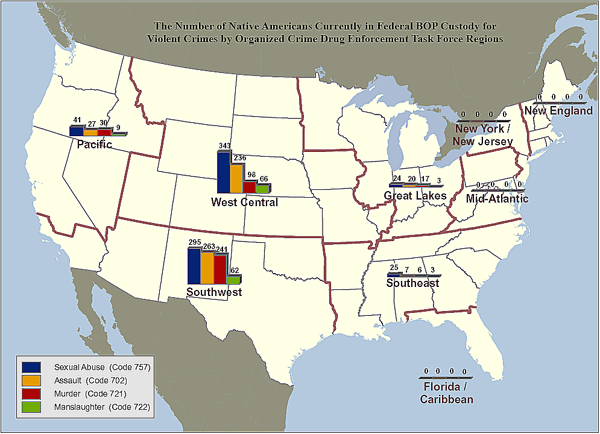
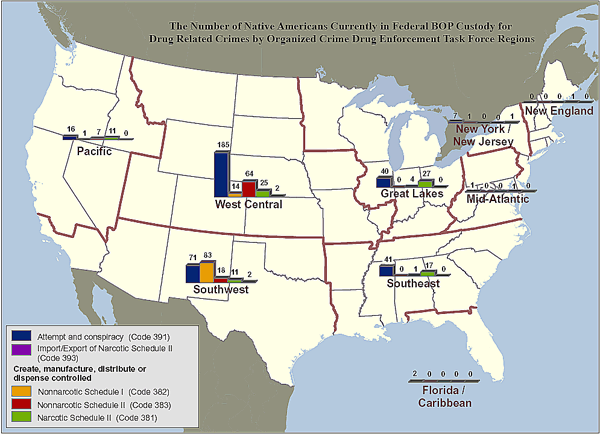
Native Americans committed to custody with the Federal Bureau of Prisons (BOP)9 have been incarcerated for a wide range of criminal offenses. The majority of Native Americans currently in the custody of BOP are committed for violent criminal offenses that occurred on state and government reservations. Over 3,300 Native Americans are currently committed to BOP custody; over 50 percent of these prisoners are incarcerated for violent crimes, such as sexual abuse, assault, murder, and manslaughter. (See Figure 1 and Appendix D.) However, the connection between these crimes and drug trafficking activity is uncertain. Moreover, approximately 19 percent of Native Americans committed to BOP custody are incarcerated for drug-related crimes, and over 12 percent are incarcerated for firearms crimes. (See Figure 2 and Figure 3 as well as Appendix D.)
Figure 1. Native Americans committed to BOP custody for violent crimes.
Figure 2. Native Americans committed to BOP custody for drug offenses.
Figure 3. Native Americans committed to BOP custody for firearms offenses.
The majority of Native Americans in BOP custody are committed to federal facilities in the Southwest and West Central Regions. The Southeast Region also figures prominently in terms of the number of Native Americans incarcerated for firearms offenses.
8.
Because of enhanced reporting mechanism implemented
by BIA in 2006 for criminal offenses in Indian Country, trend analysis and
comparison to national level rates can not be undertaken at this time--only 1
year's worth of reliable data exists.
9.
The roster data of Native Americans committed to
Federal BOP custody for this analysis were current as of January 29, 2008. The
Bureau of Prisons uses race standards set by the Office of Management and
Budget; i.e., an American Indian or Alaska Native is a person who has origins in
any of the original peoples of North and South America (including Central
America) and who maintains tribal affiliation or community attachment. For the
purposes of this report, only U.S. citizens were included in the BOP count, and
data from Alaska federal courts of jurisdiction were excluded.
To Top To Contents To Previous Page To Next Page
To Publications Page To Home Page
End of page.