
|
National
Drug Intelligence Center
North Texas High Intensity Drug Trafficking
Area Drug Market Analysis
May 2007
Strategic Drug
Threat Developments
- Some Mexican drug trafficking organizations (DTOs) are extending
transportation and distribution operations to the North Texas HIDTA
region to avoid heightened scrutiny along the Southwest Border.
They can conceal their operations more efficiently among the growing
Hispanic population of this area than in sparsely populated areas
along the U.S.-Mexico border.
- The distribution and abuse of ice methamphetamine are expanding
throughout the North Texas HIDTA region, despite steady declines
in local powder methamphetamine production. Mexican DTOs are supplanting
decreased local production by supplying large amounts of ice methamphetamine
to the area.
- African American, Asian, and Mexican DTOs operating in the North
Texas HIDTA region are increasingly conducting drug transactions
with one another, an action that facilitates the expansion of drug
distribution networks.
- Local traffickers have increased their access to multiple drug
sources and drug types through interaction with Mexican DTOs. As
a result, local traffickers are introducing different drug types
to their customers.
- Asian DTOs from the Pacific Northwest and Canada reportedly
trade MDMA (3,4-methylenedioxymethamphetamine, also known as ecstasy)
to Mexican DTOs for cocaine in the North Texas HIDTA region, but
the extent of this practice is currently unknown.
- The abuse of Mexican black tar heroin resurfaced during the
past year in the Dallas/Fort Worth metropolitan area, particularly
in Collin County, where abuse of the drug was responsible for several
drug overdose deaths.
- The abuse of "cheese" heroin is increasing in the Dallas area
and contributed to the deaths of at least 17 local adolescents during
the past 2 years.
|
Drug Trafficking Organizations, Criminal Groups, and Gangs
Drug trafficking organizations
are complex organizations with highly
defined command-and-control structures that produce,
transport, and distribute large quantities of one or
more illicit drugs.
Criminal groups operating in
the United States are numerous and range from small
to moderately sized, loosely knit groups that distribute
one or more drugs at the retail and midlevels.
Gangs are defined by the National
Alliance of Gang Investigators' Associations as groups
or associations of three or more persons with a common
identifying sign, symbol, or name, the members of which
individually or collectively engage in criminal activity
that creates an atmosphere of fear and intimidation.
|
To Top
To Contents
HIDTA
Area Overview
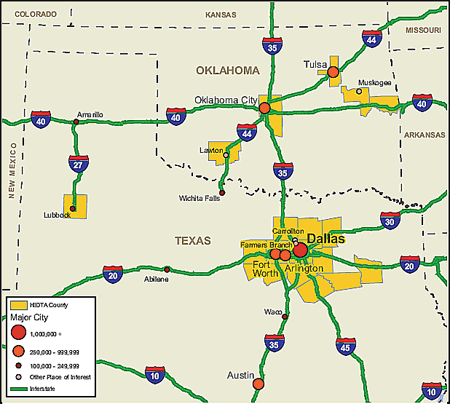
The North Texas HIDTA region encompasses 15 counties in North Texas,
clustered primarily around the Dallas/Fort Worth metropolitan area,
and 6 counties in Oklahoma, which include the Oklahoma City metropolitan
area. Most of the region's population is located in Dallas. The Dallas/Fort
Worth metropolitan area has a population of approximately 5.8 million
people; the Oklahoma City metropolitan area has approximately 1.2 million.
The North Texas HIDTA region is supported by an extensive transportation
system that provides national and international commercial connections
through numerous interstate highways, U.S. highways, railways, bus lines,
and airlines. Drug traffickers exploit the region's infrastructure to
transport and distribute illicit drugs to and from the area and to transport
illicit proceeds generated by the sales of illicit drugs to Mexico.
The North Texas HIDTA region is often a destination for illicit drug
shipments from Mexico and states along the U.S.-Mexico border; it is
also a transshipment zone for drug shipments en route to midwestern,
southeastern, eastern, and other southwestern drug markets.
Figure
2. North Texas HIDTA transportation infrastructure.
d-link
Several primary drug transportation routes in the United States traverse
the North Texas HIDTA region. Dallas, Forth Worth, and Oklahoma City
are located at the intersections of major north-south and east-west
transportation routes that lead from the Southwest Border area to interior
drug markets. Interstate 35 is the primary north-south route that affects
drug transportation into the HIDTA region. Interstate 35 begins in Laredo,
the busiest inland port of entry (POE) in the United States, and passes
through Dallas/Fort Worth and Oklahoma City, continuing to drug markets
in the West Central and Great Lakes Regions. Interstates 20 and 40 provide
access to the North Texas HIDTA region from smuggling hubs in western
Texas, New Mexico, Arizona, and California. Although I-10 does not traverse
North Texas HIDTA counties, traffickers use this route to access I-20,
which passes through Dallas/Fort Worth and extends to South Carolina.
To Top
To Contents
To Next Page
To Publications Page
To Home Page
|
