 U.S. Department
of Justice
U.S. Department
of Justice

Complaint
| This document is available in two formats: this web page (for browsing content) and PDF (comparable to original document formatting). To view the PDF you will need Acrobat Reader, which may be downloaded from the Adobe site. For an official signed copy, please contact the Antitrust Documents Group. |
| UNITED STATES DISTRICT COURT
COMPLAINT The United States of America, acting under the direction of the Attorney General of the United States, and the States of Arizona, Arkansas, California, Florida, Illinois, Iowa, Louisiana, Nebraska, Nevada, Ohio, Oregon, Rhode Island, Tennessee, Texas, and Wisconsin, and the Commonwealths of Massachusetts and Pennsylvania, acting under the direction of their respective Attorneys General or other authorized officials ("Plaintiff States") (collectively, "Plaintiffs"), bring this civil action pursuant to the antitrust laws of the United States to enjoin the proposed merger of Ticketmaster Entertainment, Inc. ("Ticketmaster") and Live Nation, Inc. ("Live Nation") and to obtain such other equitable relief as the Court deems appropriate. The United States and the Plaintiff States allege as follows: I. INTRODUCTION 1. This lawsuit challenges a proposed merger between Ticketmaster and Live Nation. If not enjoined, the merger will eliminate competition between the companies in the line of commerce of the provision of primary ticketing services ("primary ticketing") to major concert venues in the United States, in violation of Section 7 of the Clayton Act, as amended, 15 U.S.C. § 18. 2. For over two decades, Ticketmaster has been the dominant primary ticketing service provider in the United States to, among others, major concert venues. Primary ticketing, the initial distribution of tickets, has been highly profitable for Ticketmaster. Ticketmaster charges a variety of service fees, which are added to the face value of the ticket. Ticketmaster typically shares a percentage of the money from some of these fees with venues. In 2008, Ticketmaster's share among major concert venues exceeded eighty percent and its revenues from primary ticketing were much greater than that of its nearest competitor. Ticketmaster's contract renewal rate with venues typically exceeds eighty-five percent. 3. Live Nation is the country's largest concert promoter. It also controls over seventy-five concert venues in the United States, including many major amphitheaters. Live Nation had been Ticketmaster's largest primary ticketing client for a number of years. In 2007, however, Live Nation announced that it would not renew its contract with Ticketmaster. Instead, Live Nation would become Ticketmaster's direct competitor in primary ticketing when its Ticketmaster contract expired on December 31, 2008. After spending nearly two years evaluating, licensing, and developing a ticketing platform, in late December 2008, Live Nation launched its ticketing service for its own venues and potential third-party major concert venue clients. 4. Live Nation presented a new and different source of competition in primary ticketing. As a concert promoter, Live Nation could offer venues access to concert tours as an inducement to use Live Nation's ticketing service. Ticketmaster had no concert promotion business. In contrast, as both a venue owner and a concert promoter, Live Nation had economic incentives to reduce service fees on tickets in order to fill more seats and earn the associated ancillary revenue from doing so. 5. Entrants face substantial hurdles in the form of Ticketmaster's economies of scale, long-term contracts, and brand recognition as well as the technological hurdles necessary to compete in primary ticketing. Live Nation had overcome many of these by virtue of its position in promotion and venue operation and the two years it had devoted to building a ticketing platform. 6. On February 10, 2009, Ticketmaster and Live Nation announced their plans to merge. The merger would eliminate head-to-head competition between Ticketmaster and Live Nation in the provision of primary ticketing services. Unless remedied, the merger between Ticketmaster and Live Nation would substantially lessen competition for the provision of primary ticketing services in the United States in violation of Section 7 of the Clayton Act, as amended, 15 U.S.C. § 18. 7. Thus, the United States and the Plaintiff States ask this Court to enjoin this proposed merger. II. JURISDICTION AND VENUE 8. The United States brings this action under Section 15 of the Clayton Act, as amended, 15 U.S.C. § 25, to prevent and restrain Ticketmaster and Live Nation from violating Section 7 of the Clayton Act, 15 U.S.C. § 18. 9. The Plaintiff States, by and through their respective Attorneys General and other authorized officials, bring this action under Section 16 of the Clayton Act, 15 U.S.C. § 26, to prevent and restrain Ticketmaster and Live Nation from violating Section 7 of the Clayton Act, 15 U.S.C. § 18. The Plaintiff States bring this action in their sovereign capacities and as parens patriae on behalf of the citizens, general welfare, and economy of each of their states. 10. Ticketmaster and Live Nation provide and sell primary ticketing services to major concert venues in the flow of interstate commerce. Ticketmaster's and Live Nation's activities in providing and selling primary ticketing services to major concert venues substantially affect interstate commerce as well as commerce in each of the Plaintiff States. This Court has subject matter jurisdiction over this action and these defendants pursuant to Section 15 of the Clayton Act, as amended, 15 U.S.C. § 25, and 28 U.S.C. §§ 1331, 1337(a), and 1345. 11. Venue is proper in this District under Section 12 of the Clayton Act, 15 U.S.C. § 22, and 28 U.S.C. § 1391(b)(1), (c). Defendants Ticketmaster and Live Nation transact business and are found within this District. III. PARTIES AND THE PROPOSED MERGER 12. Ticketmaster is a Delaware corporation headquartered in West Hollywood, California. It is the largest provider of primary ticketing to major concert venues and others in the United States and the world. In 2008, Ticketmaster sold more than 141 million tickets valued at over $8.9 billion on behalf of more than 10,000 clients worldwide and earned approximately $1.4 billion in gross revenues. Ticketmaster also owns a majority interest in Front Line Management Group, Inc., the largest artist management group in the country. 13. Live Nation is a Delaware corporation headquartered in Beverly Hills, California. It is the world's largest promoter of live concerts, with 2008 worldwide gross revenues of over $4 billion. Live Nation's North American Music business principally involves the promotion of live music events at Live Nation owned and/or operated venues and in rented third-party venues primarily in the United States and Canada. Live Nation also owns or operates over seventy-five live entertainment venues of various sizes in the United States. This includes eleven House of Blues ("HOB") venues around the country. 14. On February 10, 2009, Live Nation and Ticketmaster entered into a definitive merger agreement providing for an all-stock "merger of equals" transaction with a combined estimated enterprise value of $2.5 billion. IV. BACKGROUND A. The Live Music Entertainment Industry 15. The components of the live music entertainment industry pertinent to this case are:
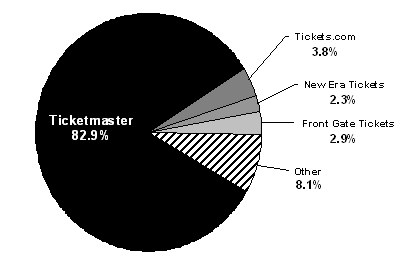
16. An artist manager serves as the "CEO" of a performer's business activities, advising in some or all phases of the performer's professional life (tours, appearances, recording deals, movies, advertising, etc.). Managers often are compensated based on a share of the performer's revenues or profits. 17. The artist manager often hires booking agents to assist in arranging a concert event or tour. The manager or booking agent contracts with promoters, such as Live Nation. Under such contracts, the promoter typically receives the proceeds from gross ticket receipts and then pays the performer, venue, and other expenses associated with the event. For example, the promoter generally contracts with the venue (or uses its own venues), arranges for local production services, and advertises and markets the concert. The promoter bears the downside risk of an event if tickets sell poorly and reaps the upside benefit if tickets sell well. 18. Venue operators provide the facilities where the events will be held and often many of the associated services, such as concessions, parking, and security. Venues traditionally receive a fixed fee for hosting an event as well as proceeds from concessions, parking, and a share of merchandise sales (which may be controlled by the performer or promoter). 19. Ticketing companies such as Ticketmaster arrange with venues -- and at times promoters -- to provide primary ticketing services. They are responsible for distributing primary ticket inventory through channels such as the Internet, call centers, and retail outlets and for enabling the venue to sell tickets at its box office. The ticketing company provides the technology infrastructure for distribution. Primary ticketing firms also may provide technology and hardware that allow venues to manage fan entry at the event, including everything from handheld scanners that ushers use to check fans' tickets to the bar codes on the tickets themselves. In some cases, primary ticketing services are provided by the venue itself. 20. The overall price a consumer pays for a ticket generally includes the face value of the ticket and a variety of service fees above the face value of the ticket. Such fees are most often charged by the provider of primary ticketing services. Venues generally receive a split of the money from ticket service fees. Often described as "convenience," "processing," and "delivery" fees, these service fees can constitute a substantial portion of the overall cost of the ticket to the consumer. B. Ticketmaster Dominates Primary Ticketing 21. Ticketmaster has dominated primary ticketing, including primary ticketing for major concert venues, for over two decades. It derives substantial revenues from ticketing for venues that host major concerts. Other companies seek to compete against Ticketmaster for primary ticketing to major concert venues, but none has been particularly successful. In fact, no other competitor (other than Live Nation) has more than a four percent share, while in 2008 Ticketmaster's share exceeded eighty percent among major concert venues. Plaintiffs have focused on the top 500 revenue generating venues in the United States as reported by Pollstar (referred to in this Complaint as "major concert venues"). Pollstar is a widely used third-party service that collects information on ticket sales. The pie chart below shows primary ticketers' shares of major concert venues, based on seating capacity: Pre-Live Nation Entry
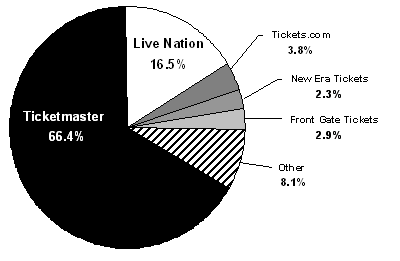
22. High shares are not the only indicators of Ticketmaster's dominance. Ticketmaster's revenues are much greater than those of the next several largest primary ticketing service competitors (other than Live Nation). Moreover, while other primary ticketing competitors do compete against Ticketmaster for primary ticketing rights at venues, Ticketmaster has had very high renewal rates. 23. Ticketmaster's costs for distributing a ticket have been decreasing as consumers increasingly purchase tickets through the Internet. The cost-per-ticket to Ticketmaster for tickets sold through its website is significantly lower than the cost-per-ticket to Ticketmaster for tickets sold over the telephone or at a retail outlet. However, ticketing fees retained by Ticketmaster have not fallen as its distribution costs have declined. C. Live Nation Decides to Enter Primary Ticketing 24. Prior to entering into primary ticketing, Live Nation had been using Ticketmaster as its primary ticketing provider for its venues and was Ticketmaster's largest customer. In late 2006, Live Nation concluded that it was unlikely to renew the Ticketmaster contract. Live Nation began considering other options for its primary ticketing needs, including operating its own primary ticketing business to ticket its own venues and to expand the service to third-party venues. 25. On Dec. 20, 2007, Live Nation announced an agreement with CTS Eventim ("CTS"), the leading German primary ticketing provider. Under the agreement, Live Nation would use CTS technology to provide primary ticketing services to Live Nation's venues as well as third-party venues in the United States. D. Live Nation Was a Competitive Threat to Ticketmaster 26. As a promoter, Live Nation's relationships with many third-party venues gave it the ability to offer third-party venues access to content. Live Nation believed that its prominence in promotions would give it immediate credibility in primary ticketing. 27. Live Nation was in a position to challenge Ticketmaster's dominance in primary ticketing due to its control of venues. Live Nation selects the primary ticketing provider for over seventy-five live entertainment venues in the United States and had been Ticketmaster's largest customer. 28. Live Nation also expected to compete on price with Ticketmaster. According to Live Nation, its concert promotion business operated on small margins, while Ticketmaster's margins from ticketing were substantially higher. Thus, entry into primary ticketing created an opportunity for Live Nation to increase its overall profit margin and disrupt Ticketmaster's business model by lowering service fees. E. Live Nation Enters Primary Ticketing 29. Live Nation's strategy was to launch Live Nation ticketing for its own venues in 2008, and then in late 2009 and early 2010 seek to compete for third-party ticketing contracts. 30. Even before launching its ticketing platform, however, Live Nation began competing with Ticketmaster to win primary ticketing contracts for third-party venues. In September 2008, Live Nation signed a multi-year ticketing agreement with SMG, the world's largest venue management company, whereby it would have certain rights to ticket SMG-managed venues as each venue's Ticketmaster contract ended. 31. Using its promotion business as a stepping stone, Live Nation also began competing with Ticketmaster for the primary ticketing contracts for other venues. This was met with some early successes. For example, in October 2008, Live Nation won the ticketing contract at the Roseland Ballroom in New York City. 32. Live Nation began selling tickets for its own and third-party venues on December 22, 2008. Almost overnight, Live Nation became the second-largest provider of primary ticketing in the United States. 33. On February 10, 2009, Live Nation and Ticketmaster entered into a definitive merger agreement. 34. Live Nation has sold millions of tickets using the CTS system. The pie chart below shows primary ticketers' shares of major concert venues, based on seating capacity, following Live Nation's entry into primary ticketing. Post-Live Nation Entry
V. RELEVANT MARKET 35. Primary ticketing services are sold pursuant to terms individually negotiated with customers. The customers most directly and adversely affected by the merger are major concert venues, which generate substantial income from live music events. Major concert venues that generate substantial income from live music events can be readily identified, and market power can be selectively exercised against them, because there is no reasonable substitute service to which the customers could turn. Nor can these customers engage in arbitrage. The provision of primary ticketing services to major concert venues is a relevant price discrimination market and "line of commerce" within the meaning of Section 7 of the Clayton Act. See U.S. Dep't of Justice, Horizontal Merger Guidelines § 1.12 (1997). 36. The United States is the relevant geographic scope of the market. Major concert venues purchasing primary ticketing services are located throughout the United States. VI. ANTICOMPETITIVE EFFECTS 37. A combination of Ticketmaster and Live Nation would lead to a high share among providers of primary ticketing for major concert venues. The set of customers most likely to be affected by the merger of Ticketmaster and Live Nation are major concert venues. Ticketmaster has the vast share of this primary ticketing business. As described in the pie chart in ¶ 21, before Live Nation entered primary ticketing, Ticketmaster had an eighty-two percent share. The next largest share was Tickets.com at less than four percent. As depicted in the pie chart in ¶ 34, with Live Nation ticketing its own venues and some third-party venues, Ticketmaster's share in this same group is reduced to sixty-six percent and Live Nation becomes the second largest ticketer with a sixteen percent share more than four times larger than Tickets.com. 38. The market for primary ticketing for major concert venues is highly concentrated. The proposed merger will further increase the degree of concentration to levels raising serious antitrust concerns as described in the Horizontal Merger Guidelines issued by the Department of Justice and the Federal Trade Commission. Id. § 1.51. 39. Using a measure of market concentration called the Herfindahl-Hirschman Index ("HHI"), defined and explained in Appendix A, the post-acquisition HHIs increase by over 2,190 points, resulting in a post-acquisition HHI of over 6,900. 40. The merger of Ticketmaster and Live Nation would eliminate Live Nation's competitive presence in the market for the provision of primary ticketing services for major concert venues, resulting in less aggressive competition, less pressure on the fees earned by Ticketmaster, and less innovation for venues and fans than would exist absent the merger. The proposed merger came at a time when Live Nation was just starting to make a competitive impact. Live Nation's ability to begin to attract third-party venues and stated intentions to compete on price likely would have resulted in increasingly competitive pricing and better services to major concert venues and consumers in the future. The proposed merger is likely to lessen competition for primary ticketing services for major concert venues. 41. The proposed merger will also reduce the merged firm's incentive to innovate and improve their respective primary ticketing services. Ticketing innovations are less likely to occur in a post-merger world in which Ticketmaster's dominance will continue and Live Nation's ticketing service has been shuttered. Notably, the benefits of quality enhancements and product variety that flow from experimentation would be far less likely to take place. VII. ABSENCE OF COUNTERVAILING FACTORS 42. Supply responses from competitors or potential competitors will not prevent likely anticompetitive effects of the proposed merger. The merged firm would possess significant advantages that any new or existing competitor would have to overcome to successfully compete with the merged firm. 43. Ticketmaster has historically possessed competitive advantages. As a result, small ticketing firms have been limited in their ability to compete. With the merger, additional entry barriers are emerging. The merged firm's promotion and artist management businesses provide an additional challenge that small ticketing companies will now have to overcome. The ability to use its content as an inducement was the point that Live Nation touted as the basis on which Live Nation could challenge Ticketmaster in ticketing. 44. No existing ticketing company or likely entrant possesses the combination of attributes to prevent the selective exercise of market power over the major concert venues by the merged firm. New entry into the provision and sale of primary ticketing services is costly and time-consuming. Major concert venues require primary ticketing services to be provided in the United States by service personnel located in the United States. It would take a new entrant a substantial investment of money and over two years to develop the combination of comparable characteristics necessary to compete with the merged firm in primary ticketing. New entry is not likely to occur in a timely or sufficient basis to prevent the anticompetitive effects that would otherwise result from the merger of Ticketmaster and Live Nation. VIII. VIOLATION ALLEGED 45. The United States and the Plaintiff States incorporate the allegations of paragraphs 1 through 44 above. 46. The proposed merger of Ticketmaster and Live Nation would likely substantially lessen competition in interstate trade and commerce in violation of Section 7 of the Clayton Act in the provision and sale of primary ticketing services for major concert venues. 15 U.S.C. § 18. 47. The proposed merger threatens to reduce competition in a number of ways, including, among others:
48. The proposed merger of Ticketmaster and Live Nation likely will have the following effects:
REQUESTED RELIEF 49. The United States and the Plaintiff States request that:
Dated: January 25, 2010
FOR PLAINTIFF STATE OF ARIZONA _______________/s/________________ FOR PLAINTIFF STATE OF ARIZONA TERRY GODDARD _______________/s/________________ FOR PLAINTIFF STATE OF ARKANSAS DUSTIN McDANIEL _______________/s/________________ FOR PLAINTIFF STATE OF CALIFORNIA EDMUND G. BROWN JR., Attorney General KATHLEEN FOOTE, _______________/s/________________ FOR PLAINTIFF STATE OF FLORIDA _______________/s/________________ FOR PLAINTIFF STATE OF ILLINOIS _______________/s/________________ FOR PLAINTIFF STATE OF IOWA _______________/s/________________ FOR PLAINTIFF STATE OF LOUISIANA _______________/s/________________ FOR PLAINTIFF COMMONWEALTH OF MASSACHUSETTS By: _______________/s/________________ FOR PLAINTIFF STATE OF NEBRASKA _______________/s/________________ FOR PLAINTIFF STATE OF NEVADA _______________/s/________________ FOR PLAINTIFF STATE OF OHIO _______________/s/________________ FOR PLAINTIFF STATE OF OREGON _______________/s/________________ FOR PLAINTIFF COMMONWEALTH OF PENNSYLVANIA By:_______________/s/________________ Jennifer A. Thomson Norman W. Marden Joseph S. Betsko Office of Attorney General FOR PLAINTIFF STATE OF RHODE ISLAND _______________/s/________________ FOR PLAINTIFF STATE OF TENNESSEE _______________/s/________________ FOR PLAINTIFF STATE OF TEXAS C. ANDREW WEBER DAVID S. MORALES JOHN T. PRUD'HOMME _______________/s/________________ FOR PLAINTIFF STATE OF WISCONSIN J.B. VAN HOLLEN By:_______________/s/________________ Appendix A DEFINITION OF HHI The term "HHI" means the Herfindahl-Hirschman Index, a commonly accepted measure of market concentration. The HHI is calculated by squaring the market share of each firm competing in the market and then summing the resulting numbers. For example, for a market consisting of four firms with shares of 30, 30, 20, and 20 percent, the HHI is 2,600 (302 + 302 + 202 + 202 = 2,600). The HHI takes into account the relative size and distribution of the firms in a market. It approaches zero when a market is occupied by a large number of firms of relatively equal size and reaches its maximum of 10,000 when a market is controlled by a single firm. The HHI increases both as the number of firms in the market decreases and as the disparity in size between those firms increases. Markets in which the HHI is between 1000 and 1800 are considered to be moderately concentrated, and markets in which the HHI is in excess of 1800 points are considered to be highly concentrated. Transactions that increase the HHI by more than 100 points in highly concentrated markets presumptively raise significant antitrust concerns under the Department of Justice and Federal Trade Commission 1992 Horizontal Merger Guidelines. CERTIFICATE OF SERVICE I, Aaron Hoag, hereby certify that on January 25, 2010, I caused a copy of the Complaint and attached Exhibits to be served on defendants Ticketmaster Entertainment, Inc., and Live Nation, Inc., by mailing the documents via email to the duly authorized legal representatives of the defendants, as follows: FOR TICKETMASTER ENTERTAINMENT, INC. FOR LIVE NATION, INC.
|