


 U.S. Department
of Justice
U.S. Department
of Justice

Bank Merger Competitive Review -- Introduction And Overview (1995)
| This document is available in three formats: this web page (for browsing content), PDF (comparable to original document formatting), and WordPerfect. To view the PDF you will need Acrobat Reader, which may be downloaded from the Adobe site. For an official signed copy, please contact the Antitrust Documents Group. |
(Current as of 9/2000)
Bank Merger Competitive Review -- Introduction and Overview (1995)
The banking agencies and the Department of Justice review the competitive impact of bank and bank holding company mergers under the banking and antitrust laws to proscribe mergers that would tend to substantially lessen competition. To speed this competitive review and reduce regulatory burden on the banking industry, the banking agencies and the Department have developed screens (attached as Screens A and B), to identify proposed mergers that clearly do not have significant adverse effects on competition. In addition to the screens, the banking agencies and the Department have identified information, described below in Section 2, which has proven to be useful in analyzing the competitive effects of proposed mergers highlighted by Screen A or Screen B.
Parties planning a merger transaction may wish to consult with the relevant banking agency or the Department before submitting an application. Where a proposed merger causes a significant anticompetitive problem, it is often possible to resolve the problem by agreeing to make an appropriate divestiture. In such cases, it may be useful to discuss the matter with the Department and the relevant regulatory agency. The Department seeks divestitures that will resolve the loss of competition in the market. A divestiture will resolve the problem if it ensures the presence of a strong and vigorous competitor that replaces the competition lost because of the merger.
Section 1 -- Screening
Banking Agencies
The banking agencies rely primarily on Screen A, which looks at competition in predefined markets developed by the Federal Reserve. If the calculation specified in Screen A does not result in a postmerger HHI over 1800 and an increase of more than 200, the banking agencies are unlikely to further review the competitive effects of the merger.(1) If the result of the calculation specified in Screen A exceeds the 1800/200 threshold, applicants may consider providing additional information. See Section 2 for a description of the types of information that may be relevant. Providing such information with a merger application can eliminate delays in the review process and may avoid special requests for additional information.
Department of Justice
The Department initially reviews transactions using data from the banking agencies' screen, Screen A. If a proposed merger exceeds the 1800/200 threshold in Screen A, applicants should consider submitting the calculations set forth in Screen B.
In some cases, the Department may further review transactions which do not exceed the 1800/200 threshold in Screen A. This is most likely when Screen A does not reflect fully the competitive effects of the transaction in all relevant markets, in particular lending to small and medium-sized businesses. For example, the Department is more likely to review a transaction involving two commercial banks if the postmerger HHI approaches 1800 and the HHI increase approaches 200, and screen A includes thrifts which are not actively engaged in commercial lending. In addition, the Department is more likely to review a transaction if the predefined market in which the applicants compete is significantly larger than the area in which small business lending competition may exist (e.g., the predefined market includes multiple counties, or is significantly larger than an RMA in which the applicants are located). In such a case, applicants should consider submitting the calculations set forth in Screen B. Often, the Department will review the information in Screen B and find no need for further review of the proposed merger.
If the calculation specified in Screen B results in an HHI over 1800 and an increase of over 200, applicants may consider providing additional information. See Section 2 for a description of the types of information that may be relevant. Providing such information with a merger application can eliminate delays in the review process and may avoid special requests for additional information.
In some limited instances, the Department may examine a transaction in further detail even though Screen A and Screen B do not identify anticompetitive problems. This is most likely to occur when it appears that:
The Screens' market area does not fit the transaction. Sometimes the geographic market used in the screens may not be an appropriate choice for analyzing the particular merger involved. For example, the Screens' market area is a county, and one merging institution is at the east end of one county and the other merging institution is at the west end of the adjacent county. The institutions may in reality be each other's most important competitors, but the screens would not reflect that fact. Or the Screens' market area may be quite large, but the merger involves two institutions at the center of the market. Institutions at the periphery of the market area may be very improbable substitutes for the competition that would be lost in the transaction and thus the transaction should be scrutinized in a narrower area to ensure that the relevant geographic market is considered.
Specialized products are involved. Sometimes the merging institutions are competitors for a specialized product and few of the institutions included in the Screens compete in offering that product. For example, the Screens likely would not identify a concentrated market for working capital loans to medium-sized commercial customers, if the market area has many institutions but the merging institutions are two of only a few institutions able to compete for such business.
In such cases, applicants may wish to submit additional information. See Section 2 for a description of the types of information that may be relevant. Providing such information with a merger application can eliminate delays in the review process and may avoid special requests for additional information.
Section 2 -- Additional Analysis
The Department and the banking agencies are likely to examine a transaction in more detail if it exceeds the 1800/200 threshold in Screen A. The Department is also likely to examine the effect of a proposed merger on competition for commercial loans if the transaction exceeds the 1800/200 threshold in Screen B. In instances where a screen highlights a transaction for further review, the applicant may present additional information not considered in the screen.
In cases where either Screen A or Screen B highlights a transaction for further scrutiny, additional information may establish a clearer picture of competitive realities in the market. Such information may include:
evidence that the merging parties do not significantly compete with one another;
evidence that rapid economic change has resulted in an outdated geographic market
definition, and that an alternate market is more appropriate;
evidence that market shares are not an adequate indicator of the extent of competition in the market, such as:
evidence that institutions in the market would be likely to expand current levels of commercial lending. Such evidence might include current loan-to-deposit ratios, recent hiring of new commercial loan officers, pending branch applications or significant out-of-market resources that would be shifted into the market in response to new loan opportunities;
evidence that a particular institution's market share overstates or understates its competitive significance (such as evidence that an institution is rapidly gaining or losing market share or that the institution is not competitively viable or is operating under regulatory restrictions on its activities);
evidence concerning entry conditions, including evidence of entry by institutions within the last two years and the growth of those institutions that have entered; evidence of likely entry within the next two years, such as pending branch applications; and expectations about potential entry by institutions not now in the market area and the reasons for such expectations, including legal requirements for entry.
In cases where Screen B highlights a transaction for further scrutiny, applicants may consider preparing an HHI worksheet for the market area using, instead of deposits, data from the relevant Reports of Condition on commercial and industrial loans a) below $250,000 and b) between $250,000 and $1,000,000. Such information can be a useful assessment of actual competition for small business lending.(2)
Additional information that may be relevant includes evidence of competition from sources not included in Screen B, such as:
evidence that a thrift institution is actively engaged in providing services to commercial customers, particularly loans for business startup or working capital purposes and cash management services;
evidence that a credit union has such membership restrictions, or lack of restrictions, and offers such services to commercial customers that it should be considered to be in the market;
evidence of actual competition by out-of-market institutions for commercial customers, particularly competition for loans for business startup or working capital purposes;
evidence of actual competition by non-bank institutions for commercial customers, particularly competition for loans for business startup or working capital purposes.
If the applicants believe that Screen B does not accurately reflect market concentration and competitive realities in a particular area, they are encouraged to submit additional information explaining the reasons for their belief. This information should include an HHI worksheet which indicates the geographical area that should be covered, the institutions that should be included, the method of calculating the market share of each institution (e.g., deposits, branches, loans), and the reasons why this information is preferable to the information supplied in Screen B. Inclusion of institutions outside the areas identified in Screen B should be supported, wherever possible, by evidence of actual competition by these institutions. Such alternative worksheets should be submitted in addition to, rather than in lieu of, the HHI worksheets from Parts A and B.
Part A: Market Screen A
A.1. List areas. If there are offices of both(3) merging institutions(4) in any:
-
- Federal Reserve market (contact the relevant Federal Reserve Bank for information on defined markets);
- Ranally Metropolitan Area (RMA), if no Federal Reserve market exists;
- county, not within any Federal Reserve market or RMA,
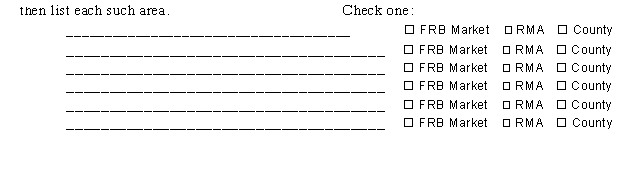
A.2. Calculate HHIs. For each area listed under item A.1, prepare an HHI worksheet (see next page) covering all banks and thrifts in the area. Follow the instructions accompanying the worksheet (including thrifts at 50 percent as explained in the instructions) to calculate the pre-merger and post-merger HHIs and the HHI increase. Prepare as many worksheets as there are market areas listed above in Item A.1.
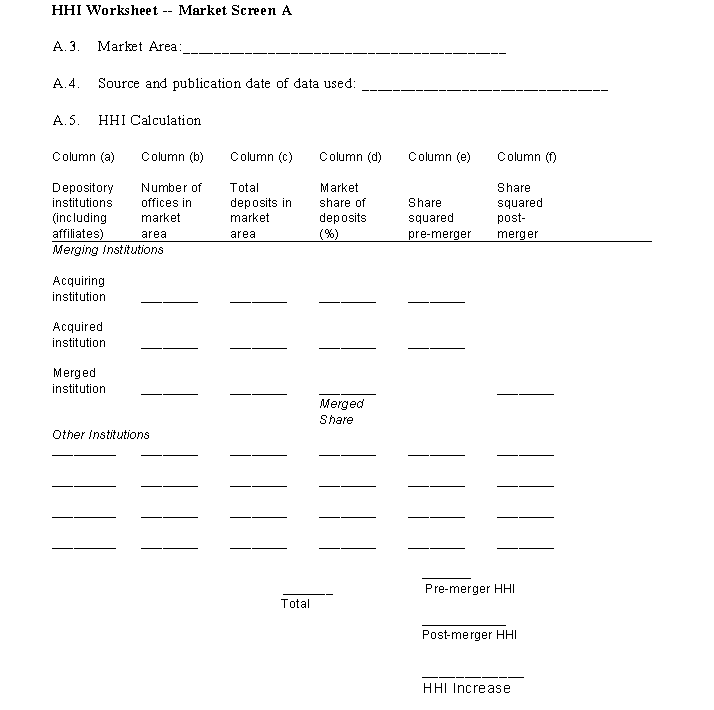
Instructions for preparing HHI Worksheets for Merger Screen A
|
Item Number |
Instruction |
|
|
Item A.3 |
Prepare a separate HHI Worksheet for each market area listed in A.1. |
|
|
Item A.5 |
Calculate an HHI for the market area, as described below. |
|
|
Item A.5.a |
In Column (a), list all the commercial banks and thrift institutions that have offices in the market area, indicating whether each is a bank or a thrift.
Affiliates. For institutions that are affiliated by common control, make only one entry that combines all affiliates together. |
|
|
Item A.5.b |
In Column (b), report the number of offices each listed institution has in the market area. |
|
|
Item A.5.c |
In Column (c), list deposits for each institutions. For commercial banks, list the total deposits that each institution (including all affiliates) has in the market area. For thrifts, list 50% of the total deposits that each institution (including all affiliates) has in the market area. Total. Add all the deposits listed in column (c) (except those in the merged institution) to get the total for the market area. |
|
|
Item A.5.d |
In Column (d), calculate the percentage market share of deposits for each institution. Use the total of column (c) as the basis of the calculation. |
|
|
Item A.5.e |
In Column (e), calculate the square of the percentage figures listed in Column (d) for the acquiring institution, the acquired institution, and the other institutions. Calculate the Pre-merger HHI by adding all of the figures in Column (e). |
|
|
Item A.5.f |
In column (f), calculate the square of the percentage figure listed in column (d) for the merged institution, and enter the figures from column (e) for the other institutions. Calculate the post-merger HHI by adding all of the figures in column (f). HHI increase. Calculate the HHI increase by subtracting the Pre-merger HHI from the Post-merger HHI. Part B: Market Screen B B.1. List areas. If there are offices of both(5) merging institutions(6) which make commercial loans(7) in any:
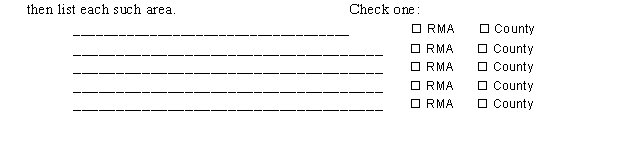
B.2. Calculate HHIs. For each area listed under item B.1, prepare an HHI worksheet (see next page) covering all commercial banks in the area. Follow the instructions accompanying the worksheet to calculate the pre-merger and post-merger HHIs and the HHI increase. Prepare as many worksheets as there are market areas listed above in Item B.1. B.6. Commercial Loans. For each merging institution, report the outstanding balance of commercial and industrial loans ("C&I loans") originated by offices in the market area. Acquiring institution: ________________ Acquired institution: ________________ |
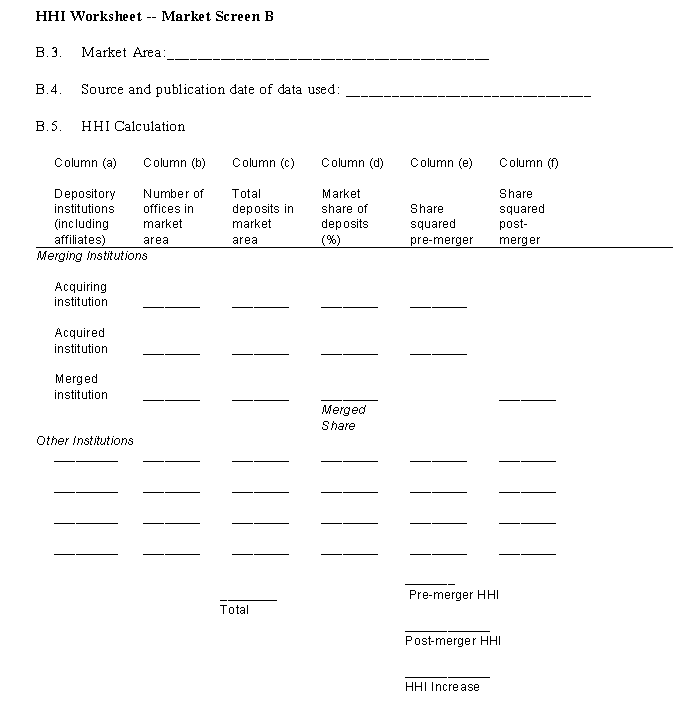
Instructions for preparing HHI Worksheets for Merger Screen B
In Column (b), report the number of offices each listed institution has in the market area.
In Column (b), report the number of offices each listed institution has in the market area.
In Column (b), report the number of offices each listed institution has in the market area.
|
Item Number |
Instruction |
|
|
Item B.1 |
For item B.1, prepare a separate HHI Worksheet for each market area in which both institutions have offices which make commercial loans. |
|
|
Item B.5 |
Calculate an HHI for the market area, as described below. |
|
|
Item B.5.a |
In Column (a), list all the commercial banks (but not thrifts) that have offices in the market area. Also list the acquired and acquiring firm, even if both are not commercial banks. Affiliates. For institutions that are affiliated by common control, make only one entry that combines all affiliates together. |
|
|
Item B.5.b |
||
|
Item B.5.c |
In Column (c), list the total deposits that each institution (including all affiliates) has in the market area. Total. Add all the deposits listed in column (c) (except those in the merged institution) to get the total commercial bank deposits for the market area. |
|
|
Item B.5.d |
In column (d), calculate the percentage market share of deposits for each institution. Use the total of column (c) as the basis for the calculation. |
|
|
Item B.5.e |
In Column (e), calculate the square of the percentage figures listed in Column (d) for the acquired institution, the acquiring institution, and the other institutions. Calculate the Pre-merger HHI by adding all of the figures in column (e). |
|
|
Item B.5.f |
In column (f), calculate the square of the percentage figure listed in column (d) for the merged institution, and enter the figures from column (e) for the other institutions. Calculate the post-merger HHI by adding all of the figures in column (f). HHI increase. Calculate the HHI increase by subtracting the Pre-merger HHI from the Post-merger HHI. |
|
|
Item B.6 |
In item B.6, indicate the outstanding balance of commercial loans originated in the market area by the acquiring and the acquired institution. "Commercial loans" are those which fall within the category entitled "commercial and industrial loans" in the FDIC Report of Condition and the category entitled "non-mortgage commercial loans" in the OTS Thrift Financial Report. |
FOOTNOTES
1. However, if a proposed merger would result in a postmerger market share in excess of 35%, the Federal Reserve is likely to review the transaction further.
2. In preparing such a market share table, parties may estimate another institution's commercial lending in a given market by multiplying the institution's overall ratio of commercial loans to deposits by its deposits in the relevant market, if market-specific information regarding that institution is unavailable. Applicants should indicate which figures are actual and which are estimates.
3. This document is written for a situation in which only two institutions are involved. In a transaction in which more than two institutions are involved, treat each reference to "both" or "two" institutions as if it referred to "two or more" institutions.
4. Including their affiliates. All subsequent references to "institutions" include all affiliates.
5. This document is written for a situation in which only two institutions are involved. In a transaction in which more than two institutions are involved, treat each reference to "both" or "two" institutions as if it referred to "two or more" institutions.
6. Including their affiliates. All subsequent references to "institutions" include all affiliates.
7. As defined in the FDIC Report of Condition as "commercial and industrial loans," and in the OTS Thrift Financial Report as "non-mortgage commercial loans."