


 U.S. Department
of Justice
U.S. Department
of Justice

A Daubert Discipline for Merger Simulation
Daubert v. Merrell Dow Pharmaceuticals, Inc., 509 U.S. 579, 591 (1993)
A Daubert Discipline for Merger Simulation
Presentation by
Gregory J. Werden
Senior Economic Counsel
Antitrust Division U.S.
Department of Justice
Merger Enforcement Workshop
February 18,2004
The views expressed herein are not purported to reflect those of the U.S. Department of Justice
Merger Simulation: Advantages
- Merger simulation provides quantitative predictions of unilateral price effects.
- Merger simulation makes it easy to account for the short-term effects of synergies on prices.
- Merger simulation can focus an investigation or trial by identifying critical facts or assumptions.
Merger Simulation: Concept
If the same, well-specified oligopoly model reasonably describes the outcome of the competitive process both before and after a proposed merger, that model can be used generate a quantitative prediction of the merger's unilateral competitive effects, after it is first calibrated to match the prices, shares, etc. that would prevail but for the merger.
Merger Simulation: Limitations
- No economic model captures every nuance of the real world, but it need not to be useful.
- Price-increase predictions are only rough estimates, but that is better than none at all.
- Merger simulation predicts only near-term effects, but Section 7 focuses such effects.
Discipline from the Rules of Evidence
Before merger simulation can be used at trial, it must pass screens for admissibility of evidence, which should be applied whenever simulation predictions are to be given significant weight.
-
- Federal Rules of Evidence 702
- Daubert, Joiner, and Kumho Tire
- Many applications in antitrust cases
Expert Knowledge
- "An expert is someone who knows some of the worst mistakes that can be made in his subject and who manages to avoid them." Werner Heisenberg (1969)
- Among the worst mistakes in a merger simulation is improper model calibration, which makes predictions meaningless.
Principles for Applying Rule 702 to Expert Economic Testimony
Expert economic testimony is admissible if:
- the witness is an expert in the relevant field of economics;
- the testimony employs sound methods from the relevant field of economics; and
- the testimony reliably applies those methods to the facts of the case.
Sound Methods
- Merger simulation is theoretically sound because it employs standard economic models.
- The empirical soundness of merger simulation, i.e., its predictive accuracy, is unknown.
- Prediction accuracy also is unknown for every alternative to merger simulation.
Fitting the Facts: Dictum
Expert testimony is admissible only if it is "sufficiently tied to the facts of the case that it will aid the jury in resolving a factual dispute," i.e., only if there is a good "fit" between the testimony and the inquiry.
Fitting the Facts: Precedent
The testimony of Robert Hall was excluded, and a substantial damage award vacated, because his oligopoly model was "not grounded in the economic reality of the" industry.
Concord Boat Corp. v. Brunswick Corp., 207 F.3d 1039 (8th Cir. 2000)
Fitting the Facts: Dictum
A court should not "admit opinion evidence that is connected to existing data only by the ipse dixit of the expert. A court may conclude that there is simply too great an analytical gap between the data and the opinion proffered."
General Electric Co. v. Joiner, 522 U.S. 136,146 (1997)
Fitting the Facts: Precedent
The testimony of Franklin Fisher was excluded for purposes of determining damages because it contained "too many assumptions and simplifications that are not supported by real-world evidence."
American Booksellers Association, Inc. v. Barnes & Noble, Inc., 135 F. Supp. 2d 1031 (N.D. Cal. 2001)
Fitting the Facts: Key Elements
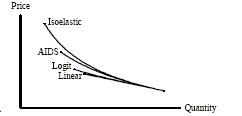
The oligopoly model used in a simulation must reflect critical aspects of competition in the short term, and explain the recent past at a high level of generality, especially the intensity of competition reflected in price-cost margins.
Sensitivity to the Demand Assumption
|
|
Fitting the Facts: Ultimate Test
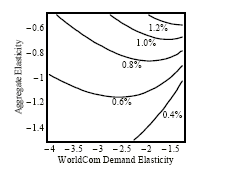
Every modeling choice should be justified on the grounds that it is: dictated by economic theory, supported by industry data, consistent with stylized facts, unimportant, or conservative.
Sensitivity to Elasticity Estimates
|
|