



Attorney General: Caleb Cushing

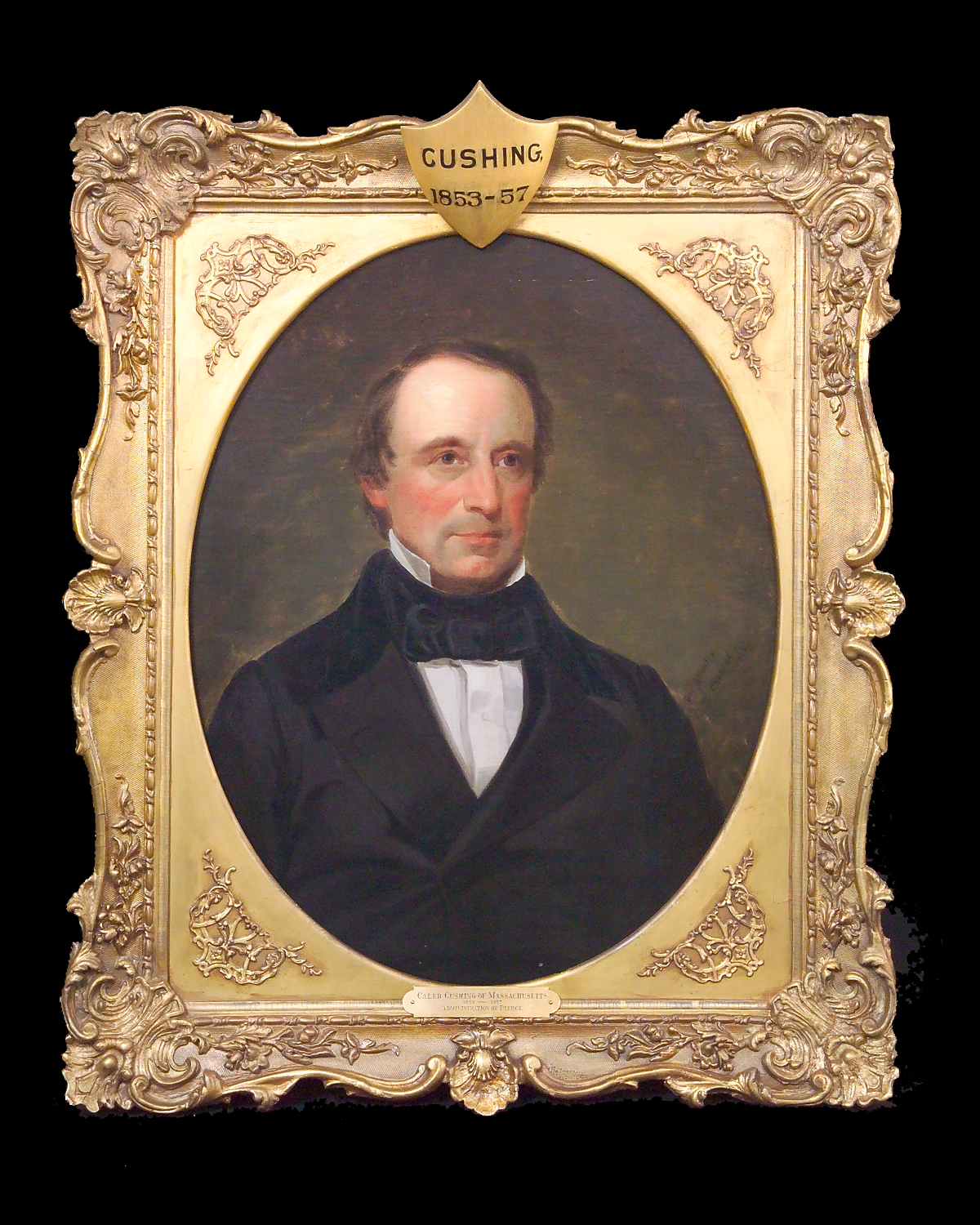
Caleb Cushing was born in Salisbury, Massachusetts, on January 17, 1800. He entered Harvard at age 13, graduating in 1817. He studied law and was admitted to the bar in 1821. Cushing was elected to the Massachusetts General Court in 1824. He was elected to the U.S. House of Representatives in 1834, serving four consecutive terms until 1843. On May 8, 1843, Cushing was appointed U.S. Commissioner and Envoy Extraordinary and Minister Plenipotentiary to China, where in 1844 he negotiated the first bilateral agreement between the United States and China, the Treaty of Wanghia. After the outbreak of the Mexican-American War in 1846, he raised, at his own expense, a Massachusetts volunteer regiment whose officers elected him colonel. From 1850 to 1852, he again served in the Massachusetts legislature, then was appointed associate justice of the Massachusetts Supreme Court.
On March 7, 1853, Cushing was appointed Attorney General of the United States by President Franklin Pierce. He held that office until March 3, 1857. From 1857 to 1859, Cushing served in the Massachusetts legislature, and in 1860, President James Buchanan sent him to Charleston, South Carolina, as a confidential commissioner to delay proclamation of that state’s secession ordinance. In 1866, he served as one of three commissioners to revise and codify the statutes of the United States. President Andrew Johnson sent Cushing to Bogotá in 1868 to further negotiations for a ship canal across the Isthmus of Panama. In 1872, he was an American counsel at the Geneva Tribunal Arbitration. From 1874 to 1877, Cushing was U.S. Minister to Spain, appointed by President Ulysses S. Grant. He died in Newburyport, Massachusetts, on January 2, 1879.
Born in western New York in 1814, John Mix Stanley became a portrait and landscape painter that specialized in scenes of Native American life. He deposited his "Indian Gallery" of 152 paintings with the federal government, intending to sell them, in 1852. While the U.S. Congress declined to purchase his canvases, they remained in the Smithsonian Institution in Washington, D.C., for several years. Much of his collection was destroyed by a fire at the Smithsonian in 1865. Stanley's portrait of Attorney General Cushing was painted in 1857. Stanley died in 1872.